STAGE 1 – STABILISE

Written by Sarah ‘Sy’ Taylor
Former First Responder – Trauma-Informed Writer – Founder of The Inner Growth Path
Writing from lived experience of PTSD, prolonged stress and identity disruption
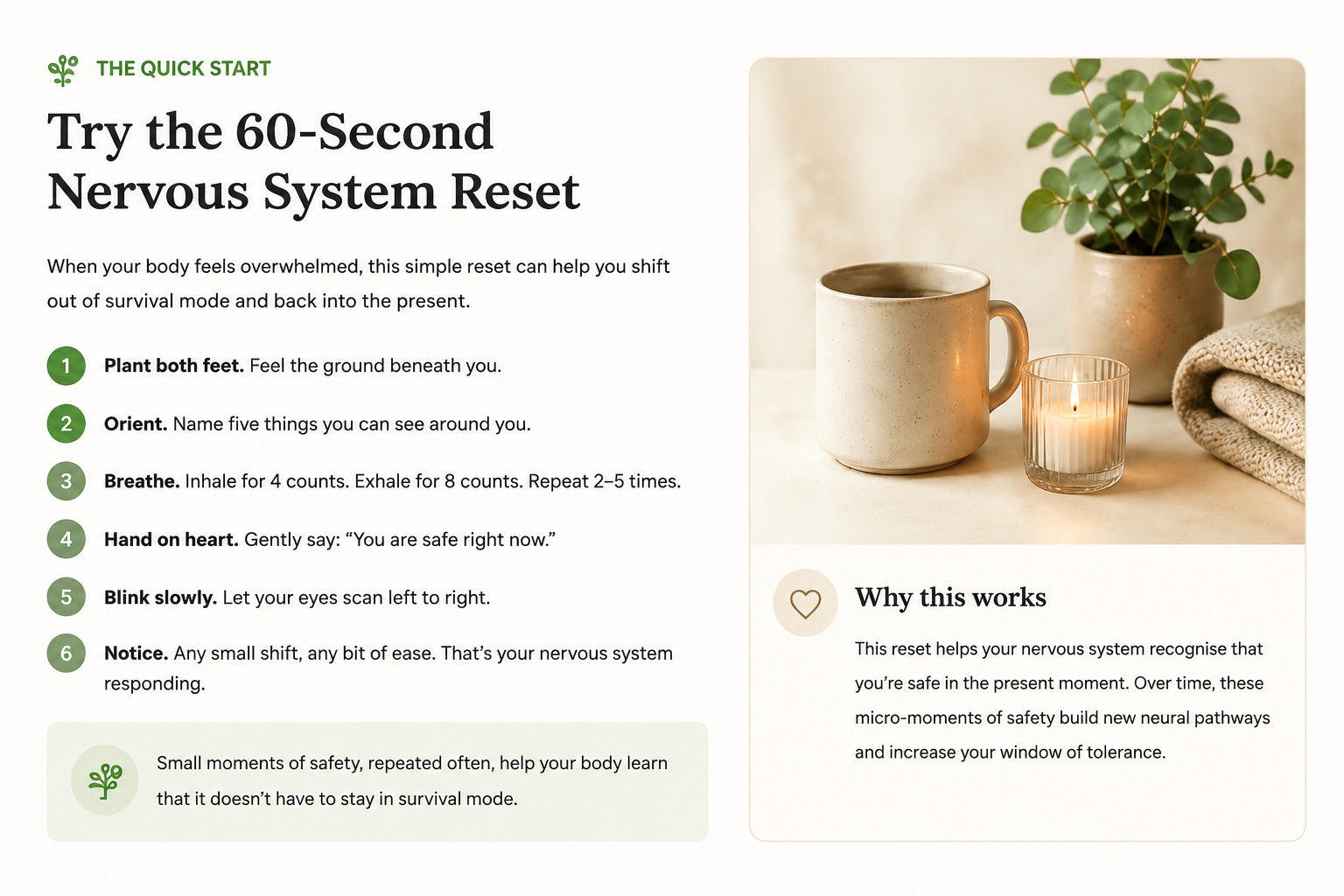
A 60-Second Grounding Option
If you arrived here feeling overwhelmed, begin with something practical. This short exercise uses orientation, physical contact and gentle breathing to help you notice the present moment. It will not resolve trauma in sixty seconds, but it may help create a little more space around what you are feeling.
Try this if you need something simple before reading further.
- Look around slowly. Let your eyes notice the room rather than staring at one point.
- Feel physical support. Notice your feet on the floor, your back against the chair or another place where your body is supported.
- Name five things you can see. Choose ordinary details such as colours, shapes or objects.
- Let your exhale lengthen gently. Do not force a particular count. If focusing on breathing feels uncomfortable, return to looking around the room.
- Use a truthful grounding phrase. Try: “I am here. This is the present. I can take the next moment slowly.”
Notice: You do not have to feel completely calm for this to be useful. The aim is orientation—not forcing your body into relaxation.
If this makes things worse: Stop if focusing on your body or breathing increases panic, dizziness, detachment or distress. Look outward, contact someone safe or seek appropriate support instead.
A note before you continue: This article discusses trauma, PTSD, panic, exhaustion and shutdown. Pause whenever you need to.
The exercises are educational options, not medical treatment or a guaranteed way to change how you feel. Persistent, severe or worsening physical or psychological symptoms deserve appropriate professional assessment.
THE SHORT ANSWER
Nervous-system regulation does not mean remaining calm all the time. It means having enough flexibility to respond to stress and gradually return towards a more manageable state.
After trauma or prolonged stress, that return can become difficult. You may remain activated, become emotionally overwhelmed or move into numbness and shutdown. Regulation begins by reducing unnecessary load, noticing what is happening and choosing support that feels tolerable—not by forcing your body to relax.
Continue understanding: If constant alertness and an inability to relax are your main experience, read What Survival Mode Really Is.
Where This Fits in the Identity Rebuild Path
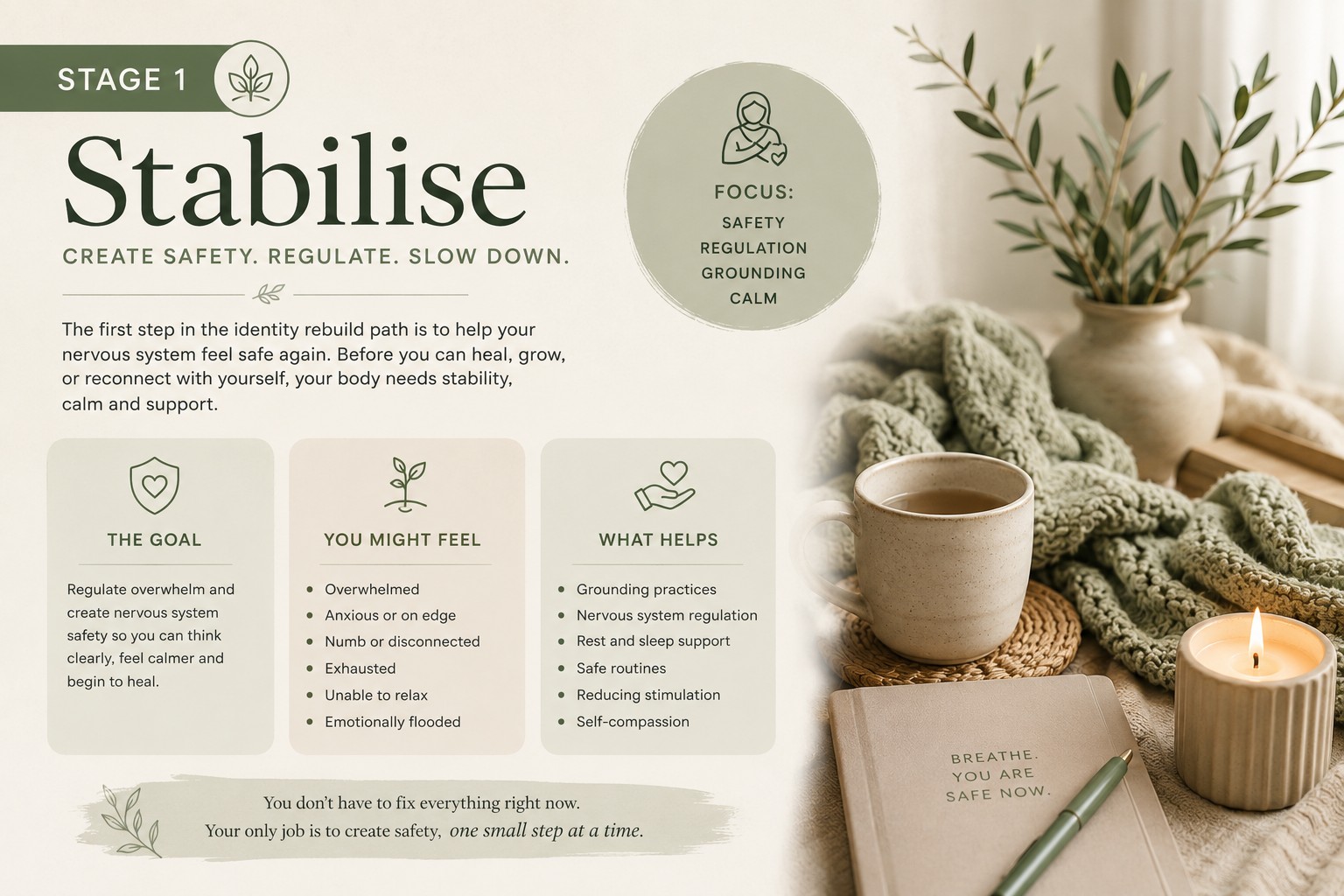
This article is part of Stage 1 — Stabilise.
Stabilisation focuses on reducing immediate overwhelm, meeting basic needs, finding appropriate support and recovering enough capacity for the next step.
You do not need to understand your entire past while you are struggling to function in the present.
What Nervous-System Overwhelm Felt Like for Me
There wasn’t a single moment where I “knew.” It was a slow collapse. A thousand micro-fractures that finally gave way. On the outside I looked like I was coping—showing up, pushing through, being the strong one. Inside, my nervous system was crumbling.
I remember lying on my parents’ couch, unable to move. Not metaphorically—my body would not move. My chest tight. Breath shallow. Hands trembling. My whole body whispering: We can’t survive like this anymore.
I wasn’t “just stressed.” I wasn’t “burnt out.” At the time, I understood it as complete physical and emotional overwhelm. I was later able to make sense of my experience through professional support, PTSD treatment and a broader assessment of my health.
If you’re here—confused, numb, exhausted, or living on edge—you are not failing. If you recognise yourself here, it does not tell you exactly why this is happening—but it does mean your experience deserves care, attention and appropriate support.
Continue understanding: Read PTSD in the Body: How Trauma Can Affect the Nervous System and Physical Health.
What Nervous-System Regulation Actually Means
Regulation is not a permanent state of calm. A healthy nervous system still responds to danger, pressure, conflict, loss and uncertainty.
The important capacity is flexibility: becoming activated when something requires a response, remaining within a manageable range when possible and gradually settling when the demand has passed.
After trauma or prolonged stress, that flexibility may become more difficult. Some people remain tense and watchful. Others feel flooded, numb, exhausted or disconnected. Many move between these experiences.
“Dysregulation” describes difficulty managing or recovering from a state—not a personal failure and not a diagnosis by itself.
Signs Your System May Be Overwhelmed
- You feel alert even when nothing urgent is happening.
- Your body feels tense, restless or unable to settle.
- You are exhausted but find rest uncomfortable.
- Small decisions feel unusually difficult.
- You feel emotionally numb or distant.
- You scan other people for changes in mood or behaviour.
- You become reactive, defensive or easily startled.
- You feel present physically but disconnected internally.
- Sleep does not leave you feeling restored.
- You keep functioning until you suddenly cannot.
These experiences can occur for several reasons, including trauma, anxiety, grief, depression, prolonged stress, sleep problems, medication effects and physical health conditions. They are signals worth noticing—not a diagnosis.
Continue understanding: Read What Survival Mode Really Is if you want a deeper explanation of why alertness can continue after danger has passed
Why Pushing Through Became My Normal
“I’m not a first responder. Is this relevant?”
You don’t need to have experienced a traumatic career to understand this pattern. Many people learn to override their body’s signals—through work, caregiving, relationships, responsibility, or simply years of needing to be strong. First responders are just one example of what happens when survival becomes a way of life.
As a police officer, I learned to remain functional while my body was telling me something was wrong. The role rewarded composure, speed, vigilance and the ability to continue through distress.
The cultural messages were often clear:
- “This job isn’t for everyone.”
- “If you can’t handle it, perhaps you shouldn’t be here.”
The lesson many of us absorbed was that needing help meant failing the role. Feelings were postponed, fatigue was overridden and distress was managed privately.
I eventually reached a point where leaving the house felt almost impossible. I cannot reduce that collapse to one nervous-system explanation. PTSD, prolonged stress, physical depletion, loss and years of overriding my limits all required attention.
You do not need to be a first responder to recognise this pattern. Caregivers, people in emotionally unsafe relationships and anyone required to remain capable for too long may learn to ignore their own signals in similar ways.
Understanding Protective Nervous-System Patterns
One accessible way of describing autonomic responses is through the language of connection, mobilisation and shutdown. This framework can help you notice patterns, but it is not a diagnostic test and people do not always fit neatly into one state.
| Pattern | Possible purpose | What it may feel like |
|---|---|---|
| Connection and relative safety | Social engagement, rest and flexible response | Present, connected and able to think |
| Mobilisation | Preparing to act, escape or confront | Restless, vigilant, angry or urgent |
| Shutdown or reduced activation | Conserving energy when overwhelmed | Numb, foggy, heavy or withdrawn |
Recognising your current experience can help you choose a starting point, but you do not need to identify a precise nervous-system state before seeking support.
Protective-pattern check-in
Which Protective Pattern Feels Most Familiar Today?
Select the statements that most closely match what you are noticing right now. You may recognise more than one pattern.
This is a reflective check-in—not a diagnostic test. Fight, flight, freeze and fawn are commonly used descriptions of protective patterns. They are not clinical categories, and the same person may respond differently in different situations.
Your reflection
Select any statements that fit. Your result will appear here.
This is a reflective check-in, not a diagnostic test. Fight, flight, freeze and fawn are commonly used descriptions of protective patterns, but people do not always fit one category and the same person may respond differently in different situations.
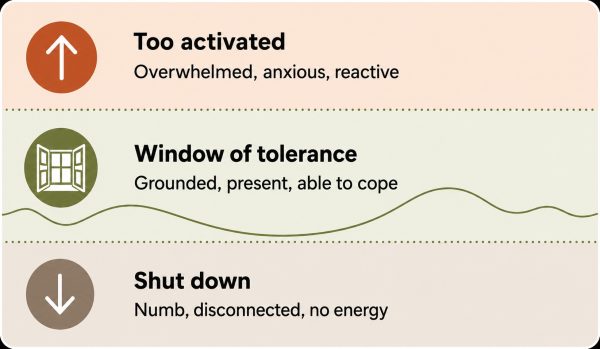
Window of Tolerance
Your window of tolerance describes the range of activation within which you can remain present, think clearly and respond with some flexibility.
After prolonged stress, that range may feel narrower: ordinary demands can become harder to manage, while shutdown may happen more quickly.
What Most Nervous-System Advice Gets Wrong
Insight Is Helpful—but It May Not Be Enough
Understanding your history can reduce confusion and self-blame. However, insight does not automatically change sleep, physical tension, avoidance, panic or shutdown. Recovery may also involve practical support, changes to your environment, medical assessment and appropriately qualified trauma treatment.
Regulation Is Not Forced Calm
Trying harder to relax can create another performance demand. A more useful starting point is noticing what increases or reduces activation and choosing an action your body can tolerate.
Physical Symptoms Still Deserve Medical Assessment
Fatigue, brain fog, sleep disturbance and changes in mood can overlap with trauma and stress, but they can also have physical causes. My own medical assessment identified deficiencies that required professional attention. I cannot assume that trauma caused every result—and neither should you.
For years, I thought healing meant finding the one thing that would finally make me calm. What I discovered was different: regulation was not about forcing myself to relax. It was about teaching my body, through repeated experiences of safety, that it no longer had to stay on guard.
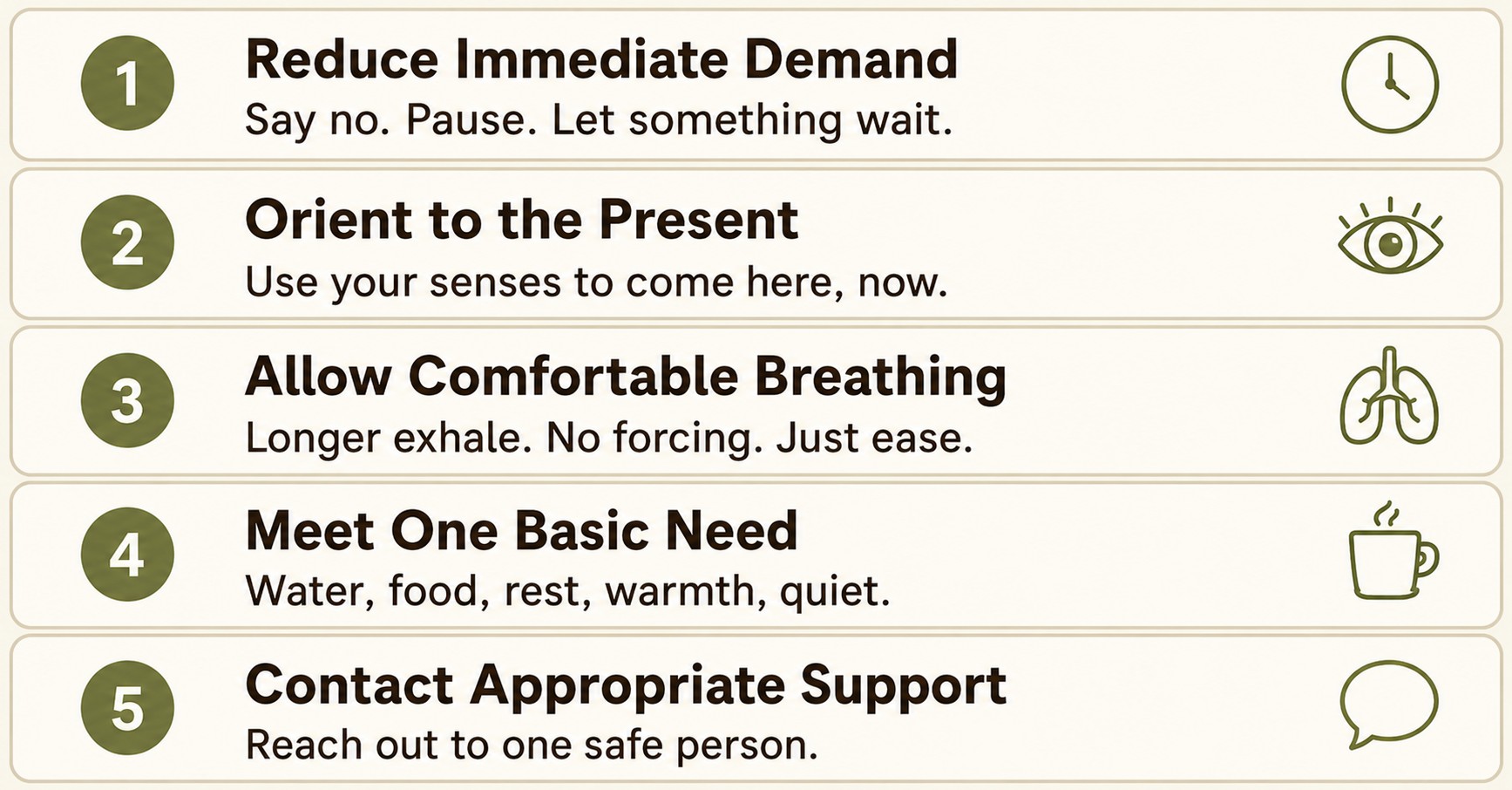
Choose One Tolerable First Step
Do not attempt every suggestion. Choose the option that feels most manageable and stop if it increases distress.
Orient to the Present
Look around slowly and name neutral details you can see.
Reduce One Source of Stimulation
Lower noise, dim harsh lighting, silence a notification or move somewhere quieter.
Use Gentle Movement
Walk slowly, stretch or shake out your hands if remaining still increases restlessness.
Create Physical Support
Sit against a firm surface, use a blanket or notice where the chair supports your weight.
Contact One Safe Person
Send a simple message: “I’m having a difficult moment. Could you stay connected with me for a few minutes?”
Small consistent steps build safety and strength.
Cold showers sometimes helped me feel more alert and present. They will not suit everyone, and I no longer treat them as a universal nervous-system recommendation.
FROM MY EXPERIENCE
What Helped Me Personally
No single practice fixed everything. Movement—including walking, freeform dance and Muay Thai—helped when I felt too activated to think clearly. Nature, grounding, gentle breathing and humming helped me reconnect with the present without forcing myself to feel calm.
Professional support mattered most. EMDR reduced the intensity of my flashbacks, trauma-informed therapy helped me understand my reactions, and group therapy with other first responders made me feel less alone.
Medical assessment also identified physical deficiencies that needed attention. This reminded me not to assume that every symptom was caused by trauma.
Spiritual practices helped me explore meaning, but I used them alongside psychological and medical care—not instead of it.
Recovery began when I stopped treating my distress as failure and started responding to myself with greater support and care.
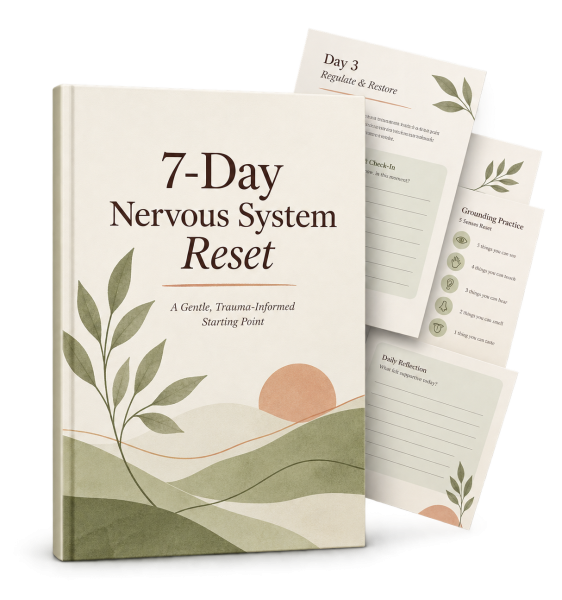
Turn What You’ve Learned Into Seven Manageable Days
When your capacity is already limited, building a complicated recovery routine can become another source of pressure. The 7-Day Nervous System Reset gives you one gentle focus each day, helping you practise regulation without trying to change everything at once.
✓ One manageable focus for each day
✓ Gentle grounding and reflection practices
✓ Complete the guide at your own pace
Digital guide • Instant access • Complete at your own pace
Educational and reflective support only. This guide is not therapy, medical treatment or a substitute for professional care.
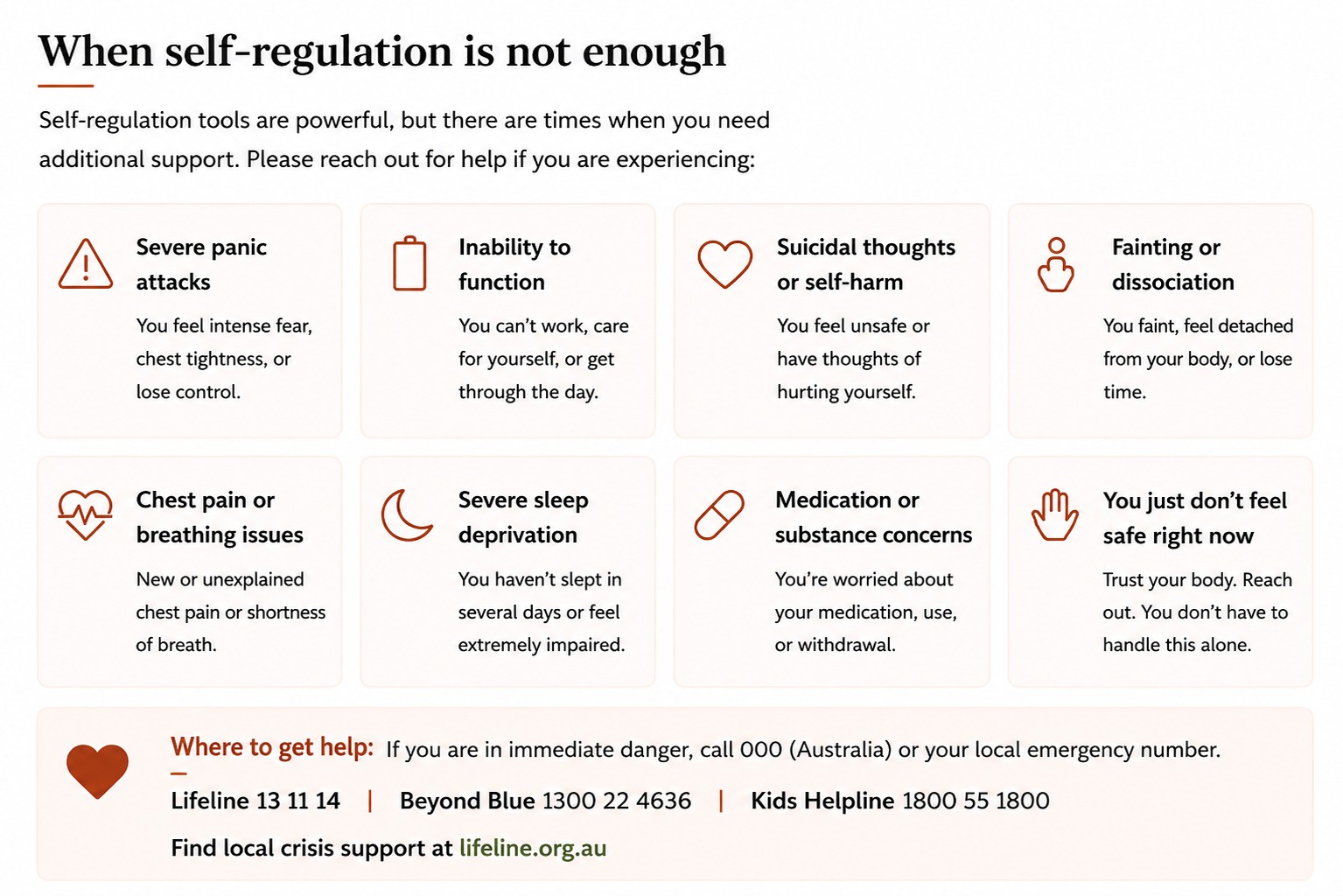
When Nervous-System Symptoms Need Additional Support
Seek assessment from an appropriately qualified health professional if symptoms are persistent, worsening, affecting daily functioning or difficult to understand.
- Severe or recurring panic
- Persistent numbness or dissociation
- Inability to sleep or function
- Significant changes in appetite, energy or concentration
- Chest pain, fainting or unexplained physical symptoms
- Medication or substance concerns
- Depression or hopelessness
- Thoughts of harming yourself or someone else
- Feeling currently unsafe
Questions About Nervous-System Regulation
Resources (Science + Help)
- Polyvagal Institute — https://www.polyvagalinstitute.org
- Somatic Experiencing Institute — https://traumahealing.org
- Phoenix Australia (PTSD) — https://www.phoenixaustralia.org
- Beyond Blue — https://www.beyondblue.org.au
- Healthdirect — PTSD
- Healthdirect — Psychological trauma
- Bessel van der Kolk / The Body Keeps the Score — https://www.besselvanderkolk.com
Note: Resources are educational and do not replace individual medical or psychological care.


IF EVERYTHING FEELS TOO MUCH RIGHT NOW
You Only Need to Begin With the Next 24 Hours
You do not need to rebuild your entire life today.
The free 24-Hour Emotional Recovery Starter Guide offers gentle, practical support for reducing immediate overwhelm, meeting basic needs and deciding what deserves your attention first.
Once the immediate shock becomes more manageable, you can begin considering what accountability, repair or separation would need to look like.