
Written by Sarah ‘Sy’ Taylor
Former First Responder – Trauma-Informed Writer – Founder of The Inner Growth Path
Rebuilding identity after emotional collapse
After trauma, betrayal, burnout, grief or prolonged stress, you may recognise your life but no longer recognise yourself within it.
Your energy, reactions, confidence and relationships may have changed. Things that once felt natural can feel difficult, while the future you previously imagined may no longer make sense.
This experience is sometimes described as identity loss after trauma. It does not necessarily mean your identity has disappeared or that trauma has permanently changed your personality. It means that protection, grief and adaptation may currently be shaping how much of yourself you can access and express.
In this article, we will look at four areas that commonly change: your emotional capacity, your behaviour, your self-trust and your sense of the future.
What Does Identity Loss After Trauma Feel Like?
Identity loss is not a formal diagnosis. It is a useful description for the experience of feeling unfamiliar, disconnected from your previous personality or uncertain about who you are after something overwhelming.
It can follow a recognisable event such as betrayal, bereavement, abuse, career loss or a traumatic experience. It can also develop gradually through burnout, chronic stress, caregiving or years of suppressing your own needs.
The experience is different for everyone. Some people feel emotionally blank; others become unusually reactive, dependent, withdrawn or uncertain. Often, the most disturbing part is not one individual symptom but the sense that your familiar responses, priorities and personality are no longer readily available.
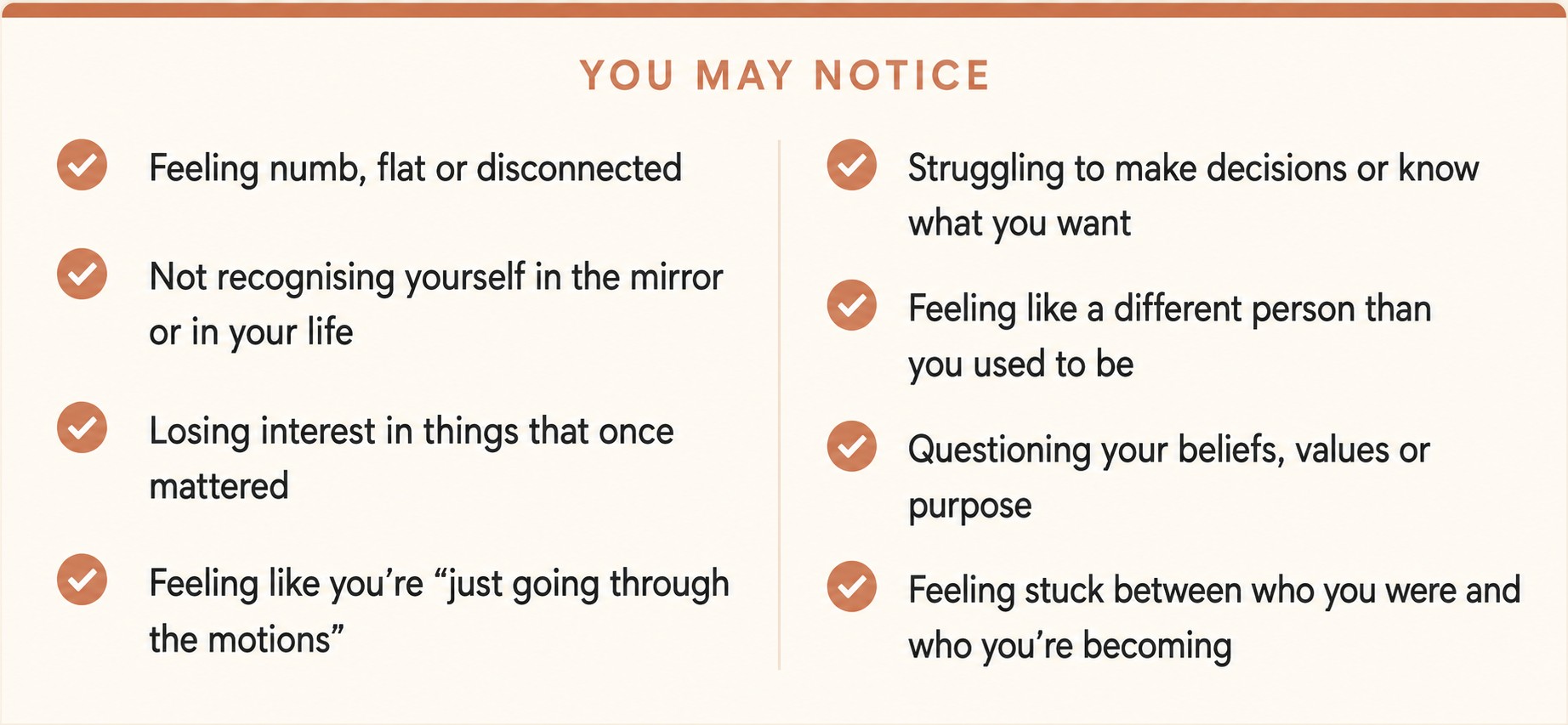
These experiences can have several causes. Trauma responses may be involved, but depression, anxiety, grief, dissociation, physical illness, medication and exhaustion can produce overlapping symptoms. A qualified professional can help if the change is severe, persistent or affecting daily life.
Identity loss is therefore a starting point for understanding your experience—not a diagnosis and not a complete explanation for every change you are noticing.
THIS IS STAGE 2: UNDERSTAND
You are not being asked to rebuild everything yet. This stage is about recognising what changed, what may have influenced those changes and why unfamiliar responses are not the whole of who you are.
Sometimes another person seems to reflect a part of you that is beginning to return. This can contribute to experiences people describe as soul recognition after trauma or identity change.
Four Ways Overwhelming Experiences Can Disrupt Your Identity
Identity is expressed through more than your personality or the labels you use to describe yourself. It appears in what you can feel, how you behave, whether you trust your own perceptions and what future you believe is possible.
When several of these areas change at the same time, it can feel as though your identity has disappeared. Looking at them separately can help you understand what has changed without turning those changes into a permanent definition of who you are.
1 — EMOTIONAL CAPACITY
You Cannot Access the Same Range of Feelings
One of the first changes you may notice after something overwhelming is a reduction in your emotional capacity.
Things that once brought excitement can feel flat. Conversations may become exhausting. You may struggle to access joy, affection, motivation or even grief. At other times, your emotions may feel so intense that you cannot concentrate on anything else.
This does not necessarily mean you have stopped caring or become an unemotional person. Numbness, emotional shutdown and reduced motivation can occur when grief, stress, exhaustion or distress have exceeded what you currently feel able to process.
Because emotions help us recognise what matters, prolonged numbness can create identity confusion. If you cannot feel your preferences, enthusiasm, anger or affection clearly, it becomes harder to answer questions such as “What do I want?” and “What matters to me now?”
Continue understanding: If numbness and depletion are your main experience, read Emotional Exhaustion After Trauma.
NOTICE THIS
Which emotions feel harder to access than they once did?
Are there certain people, places or situations in which more of your emotional range returns?
2 — PROTECTIVE BEHAVIOUR
You Behave in Ways You Do Not Recognise
Overwhelming experiences can also change how you behave around other people and how you respond to uncertainty, closeness or conflict.
You may withdraw, avoid decisions, become unusually reactive, seek constant reassurance or try to manage everything alone. You might notice people-pleasing, emotional distance, irritability, fear of vulnerability or a stronger need for control.
Some of these behaviours may be attempts to prevent further hurt. Withdrawal can reduce immediate overwhelm. Hyper-independence can reduce the risk of depending on someone unsafe. People-pleasing can feel like a way to prevent rejection or conflict.
A protective behaviour can make sense in context while still becoming restrictive over time. Understanding where it came from does not mean you must keep it. It allows you to examine the behaviour without deciding that it represents your complete personality.
ASK YOURSELF
Which behaviour feels least like the person I remember being?
When does it appear, and what might I be trying to prevent, control or protect myself from?
FROM MY EXPERIENCE
What I Mistook for a Change in My Character
After my own life fell apart, I thought I had become cold, detached and incapable of being the person I had been before. I judged the distance, exhaustion and hyper-independence as evidence that something was wrong with my character.
What changed my understanding was recognising that these were not the only truths about who I was. They were responses that had become louder while I was trying to survive PTSD, betrayal, career loss and the collapse of the future I had expected.
That did not make every response healthy, but it gave those responses a context. I could begin asking what they were protecting instead of using them as evidence that I was broken.
3 — SELF-TRUST
You Stop Trusting Your Own Experience
Identity depends partly on believing that you can recognise your own feelings, needs, boundaries and values. After trauma, betrayal or chronic invalidation, that confidence can become disrupted.
You may repeatedly question whether your reactions are reasonable. Decisions that once felt straightforward may become exhausting. You might seek other people’s opinions before trusting your own or dismiss your intuition because it was wrong, ignored or undermined in the past.
This is especially common after gaslighting, betrayal and emotionally unsafe relationships. The injury is not only that another person hurt you. You may also begin questioning your ability to recognise what was happening, protect yourself or make reliable choices.
When you no longer trust your internal experience, identity becomes harder to locate. You know that you are having thoughts and feelings, but you may no longer experience them as dependable information about who you are or what you need.
Continue understanding: If betrayal, deception or gaslighting disrupted your confidence in your own judgement, read Healing After Betrayal Trauma.
NOTICE THE DIFFERENCE
Am I gathering useful information before making this decision—or am I searching for someone else to tell me which version of my experience is real?
What do I already know about this situation before I ask someone else to interpret it for me?
4 — SENSE OF THE FUTURE
The Future You Imagined No Longer Feels Available
Identity is also connected to the future. The roles, relationships, goals and possibilities you expect help organise your sense of who you are in the present.
After betrayal, trauma, burnout, bereavement or career loss, the future around which your identity was built may disappear. You may no longer be someone’s partner, belong to the same profession, trust the same people or believe in the life you had been working towards.
Planning can then feel exhausting or pointless. You may interpret this loss of imagination as proof that you have lost your ambition, purpose or personality. In reality, you may be grieving a future as well as responding to what happened in the past.
Not knowing what comes next does not mean you no longer have a future. It means the old future may no longer be able to tell you who you are.
REFLECT
Which future, role or version of my life am I grieving?
What part of my identity had become attached to that future?
If I did not have to know what comes next yet, what loss would I allow myself to acknowledge?
WHAT THESE FOUR CHANGES HAVE IN COMMON
When your emotional capacity narrows, your behaviour becomes more protective, your self-trust weakens and your expected future disappears, it is understandable to feel as though you have lost your identity.
But these changes do not prove that nothing of you remains. They show which parts of your relationship with yourself have been placed under the most pressure.
Understanding the pattern is the purpose of Stage 2. You do not have to decide who you are becoming yet.
How Survival Responses Can Affect Your Sense of Self
A sense of safety can influence how freely you connect, explore, create and express yourself. When you feel threatened or chronically overwhelmed, more of your attention may be directed towards monitoring danger, avoiding pain or simply getting through the day.
This can make your identity feel smaller or less accessible. Curiosity may be replaced by vigilance. Openness may become withdrawal. Independence may become isolation. Spontaneity may be replaced by a need to control what happens next.
These responses are not your complete identity. They are patterns that may become more dominant while your attention and energy are occupied by protection.
However, not everyone who feels unlike themselves is “stuck in survival mode.” Grief, depression, anxiety, burnout, physical illness, medication and major life changes can create overlapping experiences. A checklist or article cannot determine their cause.
| When you have more capacity | When protection dominates |
|---|---|
| Curiosity | Vigilance |
| Connection | Withdrawal |
| Flexibility | Control |
| Emotional range | Numbness or overwhelm |
| Future planning | Getting through today |
Persistent alertness can also affect how you see yourself. Read What Survival Mode Really Is if tension, vigilance or difficulty resting is central to your experience.
A Reflection Check—Not a Diagnosis
The following questions cannot tell you whether you have trauma, PTSD, dissociation or nervous-system dysregulation. They can help you notice which changes are affecting your relationship with yourself.
Do I feel emotionally numb, detached or unfamiliar to myself?
Have I withdrawn from people or activities that previously mattered to me?
Do I regularly react in ways I do not recognise?
Do I struggle to relax even when nothing urgent is happening?
Have I lost confidence in my decisions, perceptions or boundaries?
Does my future feel blank, inaccessible or unrelated to the person I am now?
You do not need to meet a certain number of these statements for your experience to matter. Instead, notice which one is affecting your life most strongly. That may be the most useful place to seek support or continue your understanding.
When additional support may help
Consider speaking with a qualified health professional if disconnection, numbness, panic, depression or dissociation is persistent, worsening or interfering with daily life. Seek urgent local support if you may harm yourself or cannot remain safe.
Identity Disruption Is Not the Same as Brokenness
When your emotions, behaviour, confidence and expected future change at the same time, it is understandable to conclude that something fundamental has broken.
A more compassionate interpretation is that you have been responding to circumstances that exceeded your previous capacity or changed the life around which your identity was organised.
This does not mean every response is healthy, permanent or beyond your influence. It means your responses have a context. Understanding that context allows you to examine them without turning them into a permanent definition of who you are.
You do not need to romanticise what happened or feel grateful for it. You only need to stop using the ways you survived as evidence that you are defective.
“What changed in you may have helped you survive. It does not have to define everything you become.”
— Sy Taylor
Questions About Identity Loss After Trauma
Understanding why you no longer feel like yourself can reduce the fear that something inside you has permanently disappeared. When you feel ready to move from understanding the loss into practical rebuilding, begin with this guide to rebuilding your identity after trauma or major life change.



A GENTLE PLACE TO BEGIN
You Only Need to Begin With the Next 24 Hours
When everything feels too much, even the idea of recovery can become another overwhelming demand.
The free 24-Hour Emotional Recovery Starter Guide helps you focus only on what may support you today—without asking you to solve everything at once.
I created this guide from the kind of support I needed when my own life felt impossible to hold together.