A personal story about what I missed, what I carried, and what I now know
There’s a lot of pressure in policing — not just the job itself, but the way we’re expected to carry it. Always strong. Always ready. Always in control. Most of us never stop to think about what it’s costing us until we’re already bleeding from the inside.
PTSD doesn’t always come in loud, dramatic breakdowns. Sometimes, it creeps in quietly. Sometimes it looks like high performance, or perfectionism, or just being “tired.”
I know, because I lived it.
“Behind every strong uniform is a human being silently carrying what others don’t see.” — Adapted from first responder narratives
We Think It’s Just Part of the Job
A lot of symptoms go unnoticed in first responders because we’ve been conditioned to believe they’re normal. They get brushed off — or worse, hidden — because of stigma, fear, or shame. We don’t want to be seen as weak. We don’t want to let anyone down.
And in policing? There’s this unspoken rule that you wear your armour at all times. Even off duty.
I started noticing things in myself that I didn’t have language for at the time. I just knew I wasn’t okay — but I didn’t know how to say it out loud.
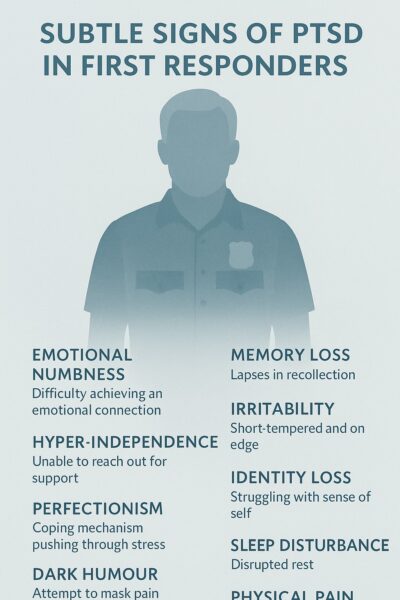
Emotional Numbness Was My First Red Flag
I couldn’t feel joy. I felt disconnected from everyone around me — even the people I loved. I was showing up physically, but emotionally? I was somewhere else.
The worst part? People praised me for how “professional” I was. For how calm I stayed under pressure. They didn’t realise I wasn’t calm. I was numb.
Hyper-Independence Almost Broke Me
I didn’t ask for help. Ever. I carried everything — the trauma, the stress, the expectations — by myself. I thought that made me strong. But really, it was just survival mode.
I became someone who took it all on. Who kept pushing through. I didn’t realise that underneath, I was falling apart.
Perfectionism Became My Safety Net
Every job stayed with me. I couldn’t let anything go. I’d obsess over calls I attended, wondering if I’d done enough, if I’d missed something, if I could’ve done better.
It wasn’t about ego — it was about control. I was trying to control the uncontrollable because I felt powerless in so many other ways.
Dark Humour Was My Escape Hatch
Black humour is part of the culture. We laugh at the darkest things, and honestly, it helps. If we didn’t laugh, we’d cry. And crying in uniform? That’s not “professional.”
But eventually, the jokes stop landing. They stop being funny. They start feeling hollow.
That’s when you know it’s not just a coping tool anymore — it’s a mask.
My Memory Started Slipping and I Just Blamed Fatigue
I’d forget why I walked into a room. I’d lose track mid-sentence. I couldn’t focus. I thought I was just tired.
But it was brain fog — cognitive fatigue from being in constant fight-or-flight. I used to pride myself on being sharp. Suddenly, I wasn’t.
And it terrified me.
I Became Irritable, Anxious, and Disconnected
I didn’t feel safe anywhere — even in calm settings. Being with my partner, around friends, in social situations… it made me edgy, withdrawn, or flat out disassociated.
My ex would get frustrated, tell me to get out of my “bad mood.” She didn’t know I was crumbling inside.
She didn’t see how hard I was trying to hold it all together — for her, for the job, for everyone but myself.
Work Became My Identity — Until I Didn’t Know Who I Was Without It
I lived for the job. I took every extra shift. I stayed back late. I showed up early. I was obsessed with helping others, with proving my worth through service.
It wasn’t just dedication. It was avoidance. Because if I stopped, I’d have to feel.
And I didn’t know how to feel anymore.
Sleep Was Never Restful
I’d wake up constantly. I had nightmares. I couldn’t fall asleep, and when I did, it wasn’t peaceful.
People said, “That’s just shift work,” but it wasn’t. It was PTSD.
My Body Was Screaming, But I Didn’t Listen
Gut issues. Chronic pain. Fatigue. I chalked it up to stress, to ageing, to poor sleep.
But it was trauma. Somatic trauma. My body was holding everything I refused to feel. And it started breaking down under the weight.
Why These Signs Get Missed
There’s a culture in emergency services that tells you to suppress, to stay stoic, to keep showing up like nothing’s wrong. You wear a mask. You carry the weight.
We fear being judged, medically retired, seen as broken. We fear the truth: that we’re not okay.
But if you’re a first responder and these symptoms feel familiar, I want you to know this:
You’re not weak. You’re human.
When I Finally Faced It, I Felt Betrayed by My Own Mind
After years of being strong, when I couldn’t hold it together anymore, I felt like I’d failed. I felt ashamed. I’d been resilient for so long — why was I falling apart now?
I didn’t realise it wasn’t failure. It was accumulation.
Trauma doesn’t always hit all at once. Sometimes it builds, slowly, over years — until one day, you realise you don’t recognise yourself anymore.
What PTSD Really Looks Like
It’s not always flashbacks and panic attacks — though I’ve had those too, especially when I suppressed things for too long.
But more often? It looks like withdrawal. Like numbness. Like over-functioning just to avoid collapse.
It looks like showing up for everyone else while silently losing yourself.
The Hardest Part? Admitting It
It starts with awareness. With looking yourself in the eye and asking:
Is this really how I want to live? Is this really who I want to be?
When I finally admitted what was going on, when I stopped saying, “I’m just tired” or “It’s just burnout,” I started to reclaim something — my power.
And slowly, my healing.
A Word for the Public — and My Fellow Officers
Police work is hard in ways the public will never understand. I remember a senior sergeant once said to me:
“It’s good the public doesn’t understand what we carry. It means we’re doing our job. It means we’re protecting them.”
He was right.
But that doesn’t mean we should suffer in silence. That doesn’t mean we should ignore our own pain just to keep serving others.
Because eventually, it catches up.
To Every First Responder: You Are Worth Helping Too
I’m proud of every one of you. I was proud to stand beside my brothers and sisters in blue. We give everything — and we do it with heart, courage, and conviction.
But at some point, we have to realise: we matter too.
We deserve support. We deserve healing. We deserve to come home to ourselves.
“Bravery isn’t the absence of fear. It’s showing up even when you’re terrified.” — Brené Brown
🧠 If This Resonated, You’re Not Alone
Whether you’re still on the job, recently retired, or just starting to feel like something isn’t right — please know there’s help. There’s a way through. And you don’t have to carry it alone.