
Written by Sarah ‘Sy’ Taylor
Former First Responder – Trauma-Informed Writer – Founder of The Inner Growth Path
Writing from lived experience of PTSD, prolonged stress and identity disruption
THE SHORT ANSWER
To calm your nervous system when you feel overwhelmed, begin by reducing stimulation, orienting to your surroundings, noticing physical support or meeting one immediate need. Gentle breathing or movement may also help—but no single technique works for everyone.
The aim is not to force complete calm. It is to create a little more orientation, support or choice.
If you need to understand why your body remains activated, read Nervous System Regulation After Trauma.
What Feels Most Manageable Right Now?
Choose the option that feels closest to what you need—not the one you think you should choose.
I need less stimulation
Lower noise, light, notifications or screen input.
I Need to Feel Present
Notice your surroundings or physical points of support.
I need something physical
Try gentle movement, touch or an unforced breath.
I Need the Smallest Possible Step
Stop adding tasks and identify one immediate need.
Before You Begin: Choose One
More techniques are not necessarily better when you are already overwhelmed. Read the titles below and choose the option that feels simplest—not the one you think you “should” do.
Stop or change strategies if you experience increased panic, dizziness, pain, breathlessness, detachment or distress. Persistent, severe or unexplained symptoms deserve appropriate professional assessment.
If you are driving, using machinery or somewhere physically unsafe: move to safety before attempting a grounding exercise.
10 Gentle Ways to Reduce Overwhelm
You do not need to complete these in order. Choose one, notice its effect and stop if it makes you feel worse. A helpful response may be subtle: slightly less tension, a clearer sense of where you are or enough capacity to decide what you need next.
GENTLE BREATHING
Let Your Breathing Become Gentler
Begin with a comfortable, ordinary breath rather than trying to take the deepest breath possible.
TRY THIS
Sit or stand in a supported position. Allow one ordinary breath to leave without pushing it. If comfortable, let the next exhale last slightly longer than the inhale. Repeat for three to five breaths.
WHY IT MAY HELP
Gently slowing the breath can give your attention a steady physical rhythm. Some people find that a comfortable, unforced exhale helps reduce physical tension.
STOP IF: You become dizzy, breathless, panicked or more detached. Return to normal breathing and choose an externally focused strategy instead.
SENSORY GROUNDING
Try a Mild Cooling Sensation
Use a comfortable temperature change to give your attention one clear physical sensation.
TRY THIS
Hold a cool—not painfully cold—cloth against your cheeks, or rinse your hands in comfortably cool water. Notice the temperature, texture and change in sensation for 20–30 seconds.
WHY IT MAY HELP
A distinct physical sensation may help redirect some of your attention away from racing thoughts and towards something happening in the present.
USE CAUTION: Avoid extreme cold, prolonged exposure or breath-holding. Skip this if cold worsens your symptoms or temperature changes are medically unsafe for you.
SENSORY AWARENESS
Notice Three Neutral Things
You do not have to find something beautiful or reassuring. Begin by noticing a few ordinary details around you.
TRY THIS
Look around slowly and name:
• Three neutral things you can see
• Two sounds you can hear
• One place where your body is supported
Take your time and notice only what feels manageable.
WHY IT MAY HELP
Sensory grounding can shift some attention away from internal overwhelm and towards information from your current surroundings.
NOTICE: If looking around the entire room feels uncomfortable, focus on one neutral object near you instead.
GENTLE MOVEMENT
Make One Small Movement
Movement does not have to be vigorous. One small, deliberate action may be enough to give restless energy somewhere manageable to go.
TRY THIS
Choose one:
• Press both feet gently into the floor and release
• Roll your shoulders once
• Shake out your hands for ten seconds
• Stand and walk to another room
• Stretch only as far as feels comfortable.
WHY IT MAY HELP
Gentle movement can provide physical feedback, ease some muscular tension and give your attention a simple action to follow.
USE CAUTION: Stop if you experience pain, dizziness, instability or increasing distress. Choose a seated or externally focused strategy instead.
REDUCE INPUT
Remove One Source of Stimulation
When your attention is already overloaded, removing one source of input may be more manageable than adding another calming exercise.
TRY THIS
Choose one change:
• Silence non-essential notifications
• Lower one light
• Pause the television or music
• Close unnecessary browser tabs
• Step away from a busy conversation
• Move temporarily to a quieter space
WHY IT MAY HELP
Reducing incoming demands can create a little more room to notice what you need and decide what to do next.
NOTICE: Which form of input feels hardest right now—sound, light, screens, conversation or competing tasks?
OPTIONAL PRACTICAL AID
If ordinary environmental noise is contributing to overload, reusable noise-reducing earplugs may help reduce sound input without requiring a completely silent room.
PHYSICAL SUPPORT
Notice What Is Supporting You
Instead of trying to make your whole body relax, begin by noticing one clear point of physical support.
TRY THIS
Choose whichever feels neutral or supportive:
• Place both feet firmly on the floor
• Sit with your back against a chair
• Lean gently against a wall
• Hold your own forearm
• Rest a cushion behind your back
• Wrap yourself in a familiar blanket
WHY IT MAY HELP
Clear points of contact can make it easier to notice where your body is and what is physically holding or supporting it.
NOTICE: Touch and pressure are not calming for everyone. If they make you feel trapped, exposed or more distressed, choose an option involving sight, sound or movement instead.
TIME AND PLACE
Orient Yourself to Where You Are
Orientation uses simple, verifiable information to reconnect your attention with your current time, place and available choices.
TRY THIS
Without rushing, identify:
• Where you are
• The approximate time of day
• The date, if you know it
• What is happening around you now
• One choice currently available to you
You might say: “I am sitting in my living room. It is Tuesday afternoon. I can stay here or move somewhere quieter.”
WHY IT MAY HELP
Naming current information may help distinguish what is happening now from memories, fears or expectations connected with another time.
NOTICE: Do not force yourself to say that you are safe if you are not sure. Use information you can verify: where you are, what you can see and what action you can take next.
ENVIRONMENTAL SUPPORT
Make the Space Easier to Be In
Your surroundings cannot resolve the cause of distress, but one practical adjustment may remove an unnecessary demand.
TRY THIS
Choose one small change:
• Move to a chair that supports your back
• Adjust the room temperature
• Bring water within reach
• Open or close a curtain
• Create a little more space around you
• Move an uncomfortable object
• Place an essential item somewhere visible
WHY IT MAY HELP
A more manageable environment can reduce the number of physical and practical demands competing for limited attention.
NOTICE: You are not trying to create a perfect calming space. Change only the part of the environment that feels most difficult right now.
NAME THE EXPERIENCE
Describe What Is Happening
If naming a specific emotion feels difficult, begin with a sensation, thought, urge or problem you can observe.
TRY THIS
Use one factual sentence:
• “My chest feels tight.”
• “My thoughts are moving quickly.”
• “Sound feels difficult to tolerate.”
• “I am having trouble deciding what to do.”
• “Part of me wants to leave.”
• “I feel disconnected and foggy.”
Then add: “I do not have to explain or solve this in this moment.”
WHY IT MAY HELP
Specific description can make the experience easier to observe without turning it into a judgement about your character or identity.
NOTICE: You do not need to find the perfect emotional label. Describe only what you can genuinely notice.
REDUCE DEMANDS
Reduce the Next Demand
When your capacity is limited, the most helpful next step may be removing pressure rather than adding another task.
TRY THIS
Ask:
“What can be postponed, declined, simplified or completed imperfectly?”
Then choose one:
• Delay a non-essential decision
• Send a brief message instead of a long explanation
• Eat something simple rather than preparing a complete meal
• Leave one household task unfinished
• Ask one safe person for practical assistance
• Choose the minimum necessary next step
WHY IT MAY HELP
Temporarily reducing demands can protect limited capacity and make it easier to identify what genuinely needs attention first.
NOTICE: Doing less is not the same as abandoning every responsibility. The smallest useful action may be rest, water, food, medication, privacy, practical help or professional care.
FROM MY EXPERIENCE
What Helped Me Stop Treating Overwhelm as Failure
When my capacity became very limited, I kept searching for the technique that would make me feel normal again. What helped was less dramatic: predictable structure, fewer unnecessary demands, quieter surroundings and small practices I could repeat without forcing a particular result.
Movement helped when I felt restless. Orientation and gentle breathing sometimes helped me reconnect with the present. Professional trauma treatment and medical assessment were more important than any self-help technique because my symptoms did not have one simple cause.
The biggest change was learning that regulation was a practice—not a test I was failing whenever I still felt distressed.
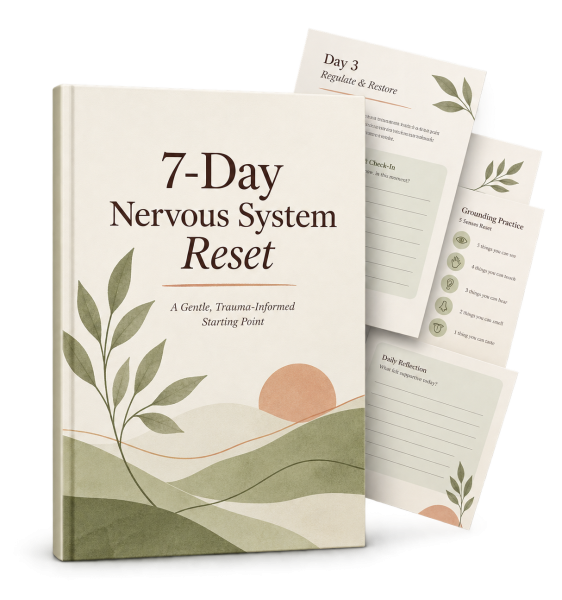
Turn What You’ve Learned Into Seven Manageable Days
When your capacity is already limited, building a complicated recovery routine can become another source of pressure. The 7-Day Nervous System Reset gives you one gentle focus each day, helping you practise regulation without trying to change everything at once.
✓ One manageable focus for each day
✓ Gentle grounding and reflection practices
✓ Complete the guide at your own pace
Digital guide • Instant access • Complete at your own pace
Educational and reflective support only. This guide is not therapy, medical treatment or a substitute for professional care.
When Calming Strategies Are Not Enough
Self-guided strategies cannot determine why symptoms are happening or replace individual assessment. Speak with an appropriately qualified health professional if symptoms are persistent, worsening, difficult to understand or affecting sleep, relationships, work or everyday functioning.
Seek help promptly for severe or recurring panic, significant dissociation, chest pain, fainting, inability to sleep or function, medication or substance concerns, hopelessness, or thoughts of harming yourself or someone else.
If you are in immediate danger in Australia, call 000. Lifeline provides 24-hour crisis support on 13 11 14.
Questions About Calming an Overwhelmed Nervous System


IF EVERYTHING FEELS TOO MUCH RIGHT NOW
You Only Need to Begin With the Next 24 Hours
You do not need to rebuild your entire life today.
The free 24-Hour Emotional Recovery Starter Guide offers gentle, practical support for reducing immediate overwhelm, meeting basic needs and deciding what deserves your attention first.
Once the immediate shock becomes more manageable, you can begin considering what accountability, repair or separation would need to look like.