


Written by Sy Taylor
Former police officer and first responder · Lived experience of PTSD and rebuilding after loss · Degrees in Law and Justice and Legal Studies
This article is educational, not therapy. If you need support now, visit Support Resources.
About Sy →
Rebuilding identity after emotional collapse
THE SHORT ANSWER
What Is Inner Growth?
Inner growth is the ongoing process of understanding yourself more clearly and allowing that awareness to change how you relate, choose and live.
It can involve recognising emotional and relationship patterns, questioning beliefs or roles that no longer fit, developing self-trust, strengthening boundaries and making choices that reflect your values rather than fear, habit or expectation.
Inner growth does not require trauma or a major life crisis. However, loss, heartbreak, burnout and identity change can expose the distance between the life you have been living and what now feels honest or meaningful.
Sometimes this involves becoming curious about the emotions, needs or protective patterns you previously learned to hide. If you are ready for that kind of self-exploration, learn how to approach shadow work safely and without forcing emotional breakthroughs.
The purpose of inner growth is not to become a flawless new person. It is to develop a more honest relationship with yourself—and increasingly live from it.
A USEFUL DISTINCTION
Inner Growth, Healing and Personal Growth Are Not the Same
These ideas often overlap, but they describe different kinds of change. Understanding the distinction can help you recognise what you actually need instead of treating every difficulty as something to overcome through more effort.
Inner Growth
Inner growth changes your relationship with yourself.
It involves developing greater awareness of your emotions, patterns, values, needs and choices. It may change how you understand yourself, how you respond to familiar situations and what you are willing to accept or pursue.
What am I becoming more aware of, and how might that change the way I live?
Healing
Healing is concerned with the impact of pain, trauma, loss or injury.
It may involve restoring safety, reducing distress, grieving what happened, receiving professional support and developing ways to live with experiences that cannot simply be undone.
Healing does not require you to find a lesson in everything that hurt you.
What needs care, acknowledgement or support?
Personal Growth
Personal growth is the deliberate development of skills, knowledge, habits or capabilities.
It might include becoming more confident, improving communication, learning something new, changing a behaviour or working toward a meaningful goal.
Personal growth can be practical and externally visible, although it may also be supported by deeper internal change.
What would I like to learn, practise or improve?
They Can Work Together
These processes are not a fixed sequence.
Healing may create enough capacity for inner growth. Inner growth may reveal which goals genuinely matter. Personal growth may give you the skills to live more consistently with what you have learned about yourself.
You can also experience inner growth while still grieving, struggling or needing support. Growth is not proof that healing is complete.
HOW CHANGE BECOMES VISIBLE
What Inner Growth Can Change
Inner growth happens internally, but its effects can gradually become visible in how you understand yourself, respond to emotion, relate to other people and make decisions.
The changes are not always dramatic. Often, they first appear as a little more awareness, a different question or one choice that no longer abandons what you know to be true.
Self-Awareness
You become more able to notice your emotional responses, protective habits and recurring patterns without immediately judging or acting on them.
The aim is not constant self-analysis. It is recognising what is happening within you clearly enough to have a choice.
Your Relationship With Emotion
You may become better able to identify, tolerate and respond to emotions rather than automatically suppressing, escaping or being directed by them.
This does not mean becoming calm all the time. It means developing more ways to remain connected to yourself when difficult feelings arise.
Identity and Self-Trust
You begin separating who you are from the roles, expectations and survival strategies that may once have defined you.
Self-trust grows through lived evidence: noticing what you need, making a considered choice and learning that you can respond when circumstances change.
Values, Boundaries and Relationships
You become clearer about what matters to you, what you can genuinely offer and what repeatedly costs you your sense of self.
This may affect how you communicate, which relationships you invest in and where you begin setting or maintaining boundaries.
Choices and Participation
Greater self-understanding can influence how you approach work, relationships, creativity, contribution and everyday life.
You may still feel uncertain. The change is that your choices become increasingly informed by curiosity, meaning and values—not only fear, habit or approval.
Change Is Rarely Even
You may experience growth in one area while continuing to struggle in another. You might understand a pattern before you can change it, set a boundary and later question it, or discover that a direction you tested does not fit.
That does not make the growth false. Inner growth develops through awareness, practice, experience and revision—not permanent perfection.

WHEN THE OLD STRUCTURE NO LONGER FITS
Why Inner Growth Often Begins After Disruption
Inner growth can develop gradually through curiosity, relationships, reflection and ordinary life experience. But it often becomes more visible after something disrupts the structure a person previously relied on.
A relationship may end. A career, home or community may change. Burnout may make an old way of living impossible to sustain. Trauma, betrayal, illness or loss may alter how safe the world feels—or how clearly you recognise yourself within it.
These experiences can bring previously avoidable questions closer:
- Who am I without this person, role or future?
- Which parts of my life were genuinely mine?
- What was I tolerating because it felt familiar?
- What do I need now that my circumstances have changed?
- What still feels true when the old structure is gone?
Disruption does not automatically produce wisdom, and pain does not need to be romanticised as a gift. Some experiences are simply harmful, unfair or deeply painful.
Growth comes not from the harm itself, but from what gradually becomes possible around it: receiving support, understanding what happened, grieving what ended, recovering a sense of choice and deciding how you want to live now.
You do not have to be grateful for what happened in order to grow beyond the limits it placed around your life.
Start With What You Need Now
If the disruption is still recent and daily life feels unsafe or unmanageable, growth may currently look like stabilising rather than searching for meaning.
If your roles and expected future have ended and you no longer recognise yourself, the next task may be rebuilding identity before choosing a new direction.
GROWTH IN REAL LIFE
What Inner Growth Actually Looks Like
Inner growth is not always obvious from the outside. It may happen long before your circumstances change or you feel confident about what comes next.
It often looks less like becoming permanently calm, certain or healed—and more like relating differently to what is already happening.
IT MAY NOT LOOK LIKE
IT MAY LOOK LIKE
Never becoming emotionally activated
Recognising the feeling sooner and creating space before responding.
Making every decision without doubt
Choosing thoughtfully and adjusting when new information emerges.
Leaving your past completely behind
Letting history remain part of your story without organising your present.
Setting perfect boundaries every time
Noticing when you override your needs and practising a different response.
Discovering one permanent identity or purpose
Testing directions and learning what feels meaningful and sustainable.
Moving forward in a straight line
Returning to support or changing direction without calling it failure.
The space between recognising a pattern and consistently responding differently is not evidence that growth is absent. It is often where practice is happening.
SIGNS OF INTERNAL CHANGE
Signs You May Be Experiencing Inner Growth
Inner growth does not have one finish line, and it cannot be measured by how positive, productive or calm you appear.
These signs are not a diagnosis or a test. They are possible indications that your awareness, choices and relationship with yourself are beginning to change.
Your Patterns Are Becoming Easier to Name
You increasingly recognise the situations, beliefs or emotional needs influencing your responses.
You may still repeat the pattern, but it no longer feels entirely invisible or inexplicable.
Your Preferences and Needs Are Becoming Clearer
You find it easier to notice what you enjoy, need, value or no longer want to tolerate.
This may begin with ordinary choices before it affects larger decisions about relationships, work or direction.
You Create More Space Before Responding
You sometimes pause, ask a question, regulate yourself or reconsider an automatic reaction.
When you do react in an old way, you may recognise it sooner and become more willing to repair what happened.
Familiar Dynamics No Longer Feel Automatically Acceptable
Roles or relationships you once considered normal may begin to feel uncomfortable, one-sided or inconsistent with your values.
This does not always mean leaving. It may mean communicating differently, setting a boundary or becoming more honest about the cost of continuing unchanged.
You Can Tolerate More Uncertainty
You become slightly more able to make a considered choice without needing a guarantee that it will be perfect.
You may also become more willing to revise a decision when experience shows you something new.
Your Choices Reflect More of Who You Are
Your decisions increasingly consider your values, needs and actual capacity—not only fear, approval, duty or an old role.
The shift may be small, but your life begins to contain more evidence of what matters to you.
Growth and Struggle Can Coexist
No single sign proves that growth is happening, and continuing to struggle does not erase the changes you have made.
You may recognise progress in one part of your life while needing considerable support in another. Inner growth is better understood as an evolving relationship with yourself than a permanent state you finally achieve.
A GROUNDED APPROACH
What Inner Growth Is Not
Inner growth can be a helpful way to understand change, but it can become harmful when it turns pain into another measure of personal failure.
You do not have to transform every difficult experience, find meaning immediately or become a permanently improved version of yourself.
Inner growth is not constant self-improvement
You do not need to monitor, fix or optimise every part of yourself.
Rest, pleasure, uncertainty and ordinary life are not interruptions to growth. Sometimes the healthiest response is to stop working on yourself and simply live.
Inner growth is not proof that you no longer struggle
Growth does not make you immune to grief, fear, trauma responses, confusion or mistakes.
A difficult day does not erase the progress you have made. Old reactions can return when you are tired, overwhelmed or reminded of something painful.
Inner growth is not turning every painful experience into a lesson
You may eventually discover meaning in what happened, but you are not required to be grateful for pain or pretend that harm occurred for a reason.
Some experiences were simply painful, unfair or outside your control.
Inner growth is not a replacement for professional support
Reflection and self-understanding can be valuable, but they do not replace appropriate mental-health, medical, legal or crisis support.
Knowing when you need help—and allowing yourself to receive it—can itself be an expression of growth.
If you need immediate or specialist help, visit the support resources page.
Inner growth is not outgrowing everyone who challenges you
Discomfort does not always mean that another person is misaligned, toxic or no longer meant for you.
Growth can also involve listening, repairing, accepting accountability and learning to tolerate respectful disagreement. The important distinction is whether a relationship allows for honesty, safety and mutual responsibility.
Inner growth is not spiritual bypassing or forced positivity
Spirituality and meaning can support recovery, but not when they are used to dismiss anger, grief, bodily responses or practical reality.
You can remain hopeful while acknowledging what hurts. You can search for meaning without denying what happened.
A More Grounded Measure of Growth
Instead of asking, “Am I healed yet?” or “Am I growing quickly enough?”, consider asking:
- Am I understanding myself more accurately?
- Do my choices increasingly reflect my values and present capacity?
- Can I take responsibility without abandoning self-compassion?
- Am I becoming more honest about what helps, what harms and what I need?
- Do I recognise when a problem requires support beyond self-reflection?
Inner growth should create greater honesty and choice—not greater pressure to perform recovery.
A PATH, NOT A PRESCRIPTION
The Five Stages of Inner Growth
Inner growth does not follow a perfectly ordered timeline. You may move between stages, revisit an earlier need or experience more than one stage at once.
The Identity Rebuild Path offers a way to identify what may support you now—without treating recovery as a race or checklist.
Stabilise
When life feels unsafe, overwhelming or impossible to manage
The first task is not reinvention. It is creating enough physical and emotional steadiness to get through the present moment.
This may involve reducing demands, supporting your nervous system and rebuilding basic routines before expecting clarity or major decisions.
You may need this stage if: You feel constantly activated, shut down, exhausted or unable to think beyond immediate survival.
Understand
When you need to make sense of what happened and why you responded as you did
Understanding helps you recognise trauma responses, relationship patterns, attachment dynamics and protective behaviours without turning them into evidence that something is wrong with you.
The aim is not endless analysis. It is enough insight to interrupt what keeps repeating.
You may need this stage if: You keep asking why this happened, why you reacted that way or why the same patterns continue.
Release
When you understand what happened but still feel emotionally tied to it
Release does not require forgetting, forgiving or pretending the experience no longer matters. It means gradually loosening the hold that a person, event, unanswered question or former future has on your present life.
You may need this stage if: Your mind understands that something has ended, but emotionally you remain organised around it.
Reconnect
When survival has quietened but you no longer know who you are
Reconnection involves recovering your preferences, needs, boundaries, values and sense of self beyond the roles you performed or the life that ended.
You do not need to recover an exact former version of yourself. You are learning to recognise who remains and who is emerging.
You may need this stage if: You feel disconnected from yourself or uncertain about what you genuinely want.
Expand
When you are ready to participate in life beyond recovery
Expansion is not constant achievement or forced positivity. It is the gradual return of possibility—the capacity to explore, create, connect and build a life that reflects what you now know about yourself.
You may need this stage if: You are relatively stable but want greater meaning, direction, connection or participation in life.
You Do Not Have to Begin at Stage One
Begin with the stage that most closely reflects your current need.
If several stages feel relevant, choose the one creating the greatest immediate barrier. Stability generally comes before deeper exploration, but growth remains personal rather than perfectly sequential.
The purpose of the path is not to tell you where you should be. It is to help you recognise what you may need next.
START SMALLER THAN YOU THINK
How to begin inner growth without overwhelming yourself
You do not need to redesign your entire life to begin inner growth.
When you have experienced trauma, loss or major change, pressure to “work on yourself” can become another source of overwhelm. A more sustainable approach is to begin with one honest observation and one manageable response.
What has actually changed?
Before deciding who you want to become, acknowledge where you are now.
Ask:
- What is taking most of my energy?
- What currently feels unstable, painful or unresolved?
- What am I expecting from myself that I may not have the capacity for yet?
This is not pessimism. It prevents you from building plans that ignore your actual emotional and physical resources.
Identify the Need Beneath the Goal
A goal often points towards a deeper need.
Wanting a new relationship may reflect a need for connection. Wanting a new career may reflect a need for meaning, autonomy or recognition. Wanting to “find yourself” may reflect disconnection from your preferences, values or identity.
Ask:
What do I hope this change would allow me to feel or experience?
The answer may reveal a smaller way to begin meeting that need now.
Choose One Area of Attention
Trying to heal your nervous system, understand every relationship pattern, rebuild your identity and plan your future simultaneously is unlikely to create clarity.
Choose the area creating the greatest immediate barrier:
- Stability
- Understanding
- Emotional release
- Reconnection with yourself
- Direction and expansion
You are not abandoning the other areas. You are choosing where your attention is most useful now.
Reduce the Size of the Next Step
If an action feels impossible, the step may still be too large.
Rebuild my social life → Send one message.
Discover my purpose → Notice which activities hold my attention.
Set better boundaries → Delay an automatic yes.
Change careers → Research one possibility.
A smaller action is not less meaningful if it is the action you can genuinely take.
Use Experiments Instead of Permanent Decisions
Inner growth often requires movement before certainty.
Treat a new interest, routine, boundary or direction as something to test. You are gathering information rather than proving that you have finally found the correct answer.
Afterwards, ask:
- Did this give me energy or drain it?
- Did I feel more like myself or less?
- What did I learn about my needs, limits or values?
- Do I want to continue, change or stop?
Notice Evidence, Not Perfection
Progress may appear in ordinary moments:
- You pause before reacting.
- You recognise a familiar pattern sooner.
- You communicate a need more clearly.
- You recover more quickly after a difficult day.
- You make one choice that better reflects your values.
- You ask for support instead of carrying everything alone.
These changes may seem small, but they are evidence that awareness is becoming lived behaviour.
A Ten-Minute Place to Begin
Take a few quiet minutes to complete these four sentences. You do not need perfect answers. The aim is simply to respond honestly to where you are now.
- The part of my life requiring the most energy right now is…
- What I may need beneath that struggle is…
- One step small enough to take this week is…
- Afterwards, I will notice whether…
Choose one action only.
You do not need to solve your whole life this week. You are creating one piece of evidence about what may support you next.
Inner growth becomes manageable when you stop demanding a complete transformation and begin responding more honestly to the life directly in front of you.

A LIVED PERSPECTIVE
What Inner Growth Looked Like in My Own Life
For much of my adult life, I understood myself through the roles I held.
I was a police officer. I was a wife. I was capable, responsible and accustomed to being the person who could cope when situations became difficult.
Those roles gave me purpose, structure and a clear sense of who I was. Then, over time, several of the foundations supporting that identity ended.
My marriage ended through betrayal. My career in policing ended after cumulative trauma. The home, future and version of myself I believed I was building no longer existed in the same form.
At first, I thought healing meant returning to who I had been before everything happened.
I wanted my energy, confidence, certainty and capacity back. I measured progress against an earlier version of myself—the person who could work under pressure, carry responsibility and keep moving regardless of what she felt.
But that version of me had also learned to override pain, minimise her own needs and connect her worth with how much she could withstand.
Returning to her completely would not have been healing.
Growth Was Not a Dramatic Reinvention
My inner growth did not arrive as a clear breakthrough or a new life plan.
It appeared gradually:
- recognising that strength did not always mean continuing;
- learning that rest was not evidence of weakness;
- noticing when I was abandoning myself to keep a relationship;
- becoming more honest about my limits;
- allowing my identity to exist beyond my career;
- understanding the difference between being needed and being loved;
- making decisions that reflected who I was becoming rather than who I had been expected to remain.
Some of those changes felt like progress. Others initially felt like loss.
Boundaries could feel like guilt. Rest could feel like failure. Letting go of a role could feel like losing part of myself. Choosing differently could disappoint people who were comfortable with the version of me who always coped.
The Path Developed From That Experience
The five stages of The Identity Rebuild Path—Stabilise, Understand, Release, Reconnect and Expand—reflect needs I encountered during my own rebuilding.
I needed stability before I could make sense of what had happened. Understanding alone did not release me from it. Letting go created space, but it did not automatically tell me who I was. Reconnection came through small choices, preferences, boundaries and experiences—not through discovering one perfect answer.
Expansion began when life stopped being only about what I was recovering from.
I do not experience these stages as completed chapters. I still move between them. There are times when growth means exploring something new, and others when it means returning to rest, support or a boundary I need to reinforce.
That is why I do not present inner growth as a straight line or promise that pain can be transformed through the correct mindset.
I see it as a gradual increase in honesty, self-trust and choice.
I did not rebuild my life by becoming the person I was before. I began rebuilding it by listening to the person who remained.
This website shares what I have learned through lived experience, reflection and trauma-informed research. It is intended to support understanding and personal reflection—not replace therapy, medical care or individual professional advice.
You can read more about my story and why I created The Inner Growth Path.
PAUSE AND NOTICE
Where Is Inner Growth Already Happening?
Inner growth is easy to overlook when you are measuring yourself only by what remains difficult.
Before searching for another problem to solve, pause and notice what may already be changing.
You do not need to answer every question. Choose the one that creates the strongest sense of recognition.
What no longer fits as comfortably as it once did?
This could be a role, relationship dynamic, expectation, belief or way of treating yourself.
What have I become more honest about?
Consider your needs, capacity, emotions, relationships, identity or the life you genuinely want.
Where do I respond differently than I might have before?
Look for small changes in your boundaries, decisions, recovery time, communication or willingness to ask for support.
What am I still trying to force back to how it was?
Notice whether you are measuring progress by your ability to recover an earlier identity, relationship, future or level of capacity.
What appears to need my attention now?
You may need greater stability, understanding, release, reconnection or room to explore what comes next.
Complete This Sentence
The growth I may not have given myself credit for is…
Write whatever comes first. It does not need to sound significant to anyone else.
Recognition matters because it changes the story from “nothing is working” to “something is already moving.”
You may still be struggling and growing at the same time.
A GENTLER PLACE TO BEGIN
Not Sure What You Need Yet?
Understanding inner growth does not mean you need to change everything at once.
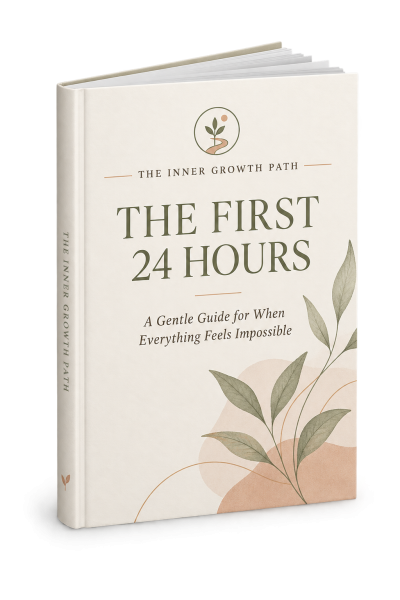
If life currently feels overwhelming—or you are unsure which part of rebuilding needs attention first—begin with the next 24 hours.
What to Do When Your Life Falls Apart is a free trauma-informed guide designed to help you reduce pressure, identify what needs attention first and choose a few manageable next steps.
Inside, you will find support to:
- recognise what may need your attention first;
- reduce unnecessary decisions and demands;
- create a calmer plan for the next 24 hours;
- respond to overwhelm without expecting yourself to fix everything immediately;
- find the most appropriate place to continue within The Identity Rebuild Path.
You do not need a complete recovery plan. You need one place to begin.
Already feeling relatively stable?
Return to the five stages above and choose the stage that most closely reflects what you need now.
The guide is delivered by email. You can unsubscribe at any time.
SOURCES AND PERSPECTIVE
How This Article Was Informed
This article combines lived experience, trauma-informed education and established psychological ideas about trauma, motivation, meaning and adaptation after major life change.
The term inner growth is used here as a broad description of changes in self-awareness, identity, values, behaviour and participation in life. It is not a clinical diagnosis or a single standardised psychological process.
The Identity Rebuild Path—Stabilise, Understand, Release, Reconnect and Expand—is an educational framework I developed to organise the different needs I encountered during my own rebuilding. It has not been clinically validated and should not be interpreted as a prescribed treatment sequence. People may move between stages, experience several simultaneously or need forms of support not represented by the framework.
The perspective in this article has been informed by:
- American Psychological Association: Trauma — an overview of trauma, common emotional responses and the ways longer-term reactions can affect wellbeing.
- National Institute of Mental Health: Coping With Traumatic Events — information about responses to trauma, recovery and when professional support may be needed.
- SAMHSA: Practical Guide for Implementing a Trauma-Informed Approach — guidance centred on safety, trust, collaboration, empowerment, voice and choice.
- Self-Determination Theory — research and theory concerning autonomy, competence, relatedness, motivation and psychological wellbeing.
- Tedeschi and Calhoun: Posttraumatic Growth—Conceptual Foundations and Empirical Evidence — foundational work examining positive psychological changes that some people report following highly challenging experiences.
- Empirically Derived Patterns of Posttraumatic Stress and Growth: A Systematic Review — research examining how distress and perceived growth may occur together following trauma.
Last reviewed: October 2026
Research into post-traumatic growth does not mean trauma is beneficial, necessary for development or guaranteed to produce positive change. Growth and distress may coexist, and no one should feel pressured to find meaning, gratitude or improvement in what harmed them.
This website provides education and reflection based on lived experience and research. It does not provide diagnosis, therapy, medical treatment or personalised mental-health advice.
COMMON QUESTIONS
Frequently Asked Questions About Inner Growth
CONTINUE FROM WHERE YOU ARE
Choose What You Need Next
You do not need to read everything or identify the perfect path.
Choose the option that most closely reflects what feels difficult or important now.
STAGE 1
I Feel Overwhelmed or Stuck in Survival Mode
Begin by reducing pressure and supporting enough stability to manage the present before expecting major insight or change.
IDENTITY LOSS
I Feel Lost and Do Not Know What Direction to Take
Identify whether you are depleted, disconnected, grieving, misaligned or ready to test a new direction.
Best next step: Why You Feel Lost in Life—and What to Do About It →
THE IDENTITY REBUILD PATH
I No Longer Know Who I Am
Learn how identity can be rebuilt after the roles, relationships or future that once defined you have changed.
Best next step: How to Rebuild Your Identity After Trauma or Loss →
I Am Ready to Build a Life Beyond Recovery
Explore meaning, possibility and participation when life is no longer organised only around what you survived.
Best next step: Explore Stage 5: Expand
You do not have to know where the whole path leads. Choose the next step that feels honest, manageable and relevant to the life you are living now.