

Written by Sarah ‘Sy’ Taylor
Former First Responder – Trauma-Informed Writer – Founder of The Inner Growth Path
Writing from lived experience of PTSD, prolonged stress and identity disruption
THE SHORT ANSWER
When your life feels as though it has fallen apart, concentrate first on immediate safety, essential physical needs and reducing non-essential demands. Avoid forcing major decisions while your capacity is severely limited. The aim of the first seven days is not to repair your entire life—it is to create enough structure and support to determine what you need next.
“Emotional collapse” is not a formal diagnosis. Similar experiences can occur alongside trauma, grief, anxiety, depression, burnout, sleep deprivation, pain, medication effects or medical conditions. Persistent, severe or unexplained symptoms deserve appropriate professional assessment.
What It Can Feel Like When Life Falls Apart
You do not need to identify the perfect explanation before taking care of yourself. Begin by noticing how reduced capacity is showing up today.
I Cannot Think Clearly
Thoughts may feel scattered, slowed down or difficult to organise.
Ordinary Tasks Feel Unmanageable
Eating, showering, replying or making appointments may require unusual effort.
I Alternate Between Numbness and Overwhelm
You may feel detached at one moment and emotionally flooded at another.
I Cannot Make Decisions
Even small choices may feel unusually consequential or exhausting.
I Do Not Recognise Myself
Your personality, confidence or usual emotional range may feel difficult to access.
Everything Feels Urgent
Urgency can make it difficult to distinguish today’s needs from future problems.
These experiences do not establish one particular diagnosis. They suggest that your present capacity may be lower than the demands currently being placed on you.
What Not to Demand From Yourself Right Now
When your capacity is severely limited, avoid creating additional pressure by trying to solve every relationship, make irreversible decisions, establish a perfect recovery routine or consume endless healing advice.
Unless immediate safety requires action, give yourself permission to postpone what does not need to be decided today.
Do Not Attempt Every Strategy
Choose one tolerable action rather than building another demanding recovery routine.
Do Not Explain Everything
You can ask for time or support without providing your complete story.
Do Not Measure Recovery Through Productivity
Completing more tasks is not the only sign that pressure is reducing.
Do Not Demand That You Feel Normal
A supportive action may help slightly without immediately changing every symptom.
Start Here: The First 24 Hours
If the next seven days feel impossible to imagine, do not plan the whole week. Begin with the most immediate layer.
Check Immediate Safety
Ask whether you are physically safe, whether another person is creating an immediate risk and whether urgent medical or crisis support is needed.
Identify Essential Physical Needs
Consider water, food, prescribed medication, sleep, warmth, hygiene, pain and anything else your body requires today.
Reduce One Demand
Postpone, decline, simplify or complete imperfectly one task that does not require your immediate attention.
Tell One Safe Person
You do not need to explain everything. A message such as “I am having a very difficult day and could use some support” is enough.
Avoid Major Decisions Where Possible
Unless safety or legal obligations require immediate action, give important decisions time until you have more information and capacity.
IF YOU CAN DO ONLY ONE THING: Meet the most immediate physical or safety-related need. Everything else can be reconsidered afterwards.
What a Seven-Day Reset Can—and Cannot—Do
A short reset can provide orientation and structure. It cannot guarantee a particular emotional or clinical outcome.
A Seven-Day Reset May Help You
- Reduce unnecessary demands
- Notice essential physical needs
- Create basic daily structure
- Record what increases or reduces pressure
- Identify where additional support may be required
- Make your next decision with more information
A Seven-Day Reset Cannot
- Diagnose the cause of your symptoms
- Guarantee nervous-system regulation
- Resolve trauma in seven days
- Replace medical or psychological care
- Make an unsafe situation safe
- Promise that you will immediately feel like yourself again
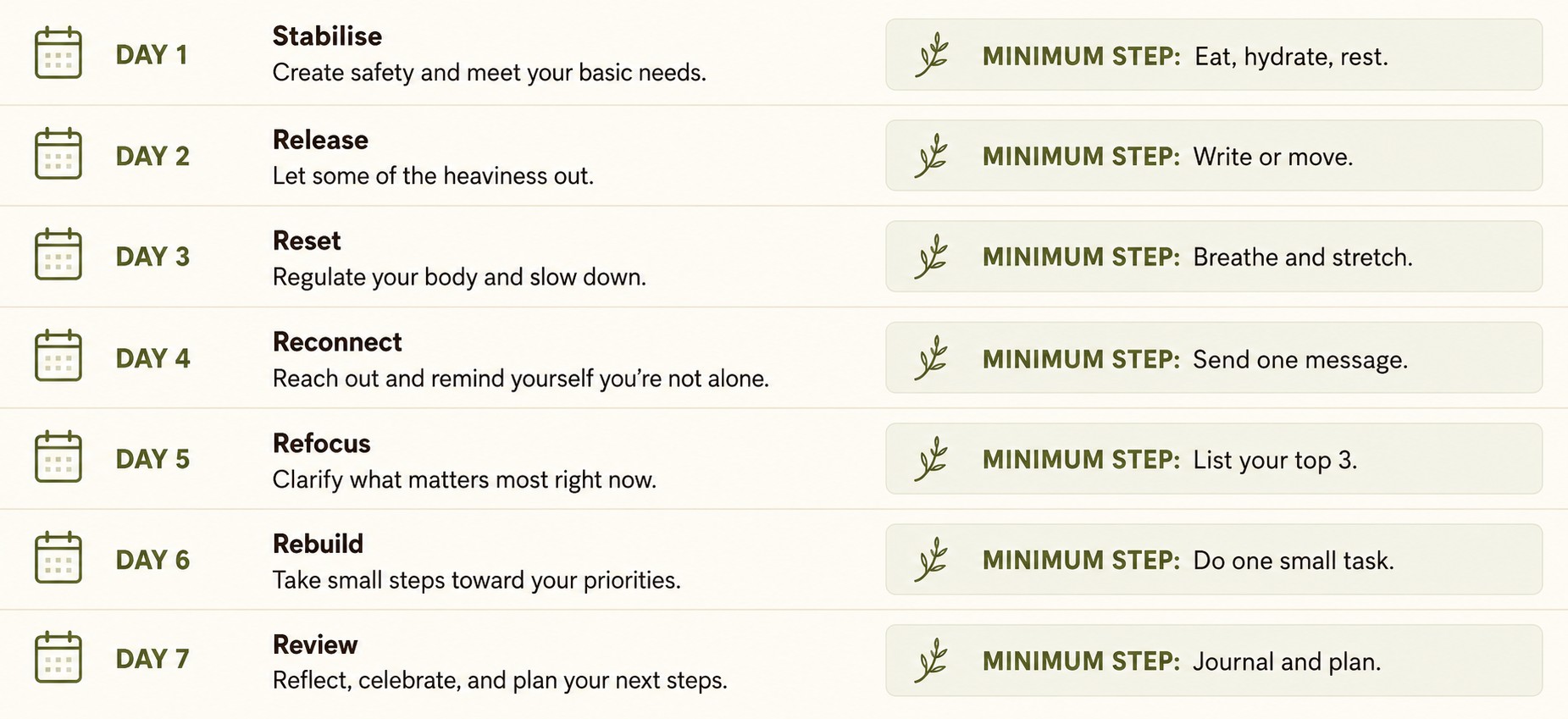
A Gentle Focus for Each of the Next Seven Days
Use these as themes rather than tests. If you miss a day, return when you can. You do not need to restart or complete the week perfectly.
FROM MY EXPERIENCE
What Helped When I Could Not Think Beyond the Next Day
When my own life fell apart, I kept believing I needed a complete plan. I searched for the right explanation, the right routine and the thing that would make me feel normal again.
What helped was smaller: fewer decisions, predictable structure, meeting basic needs and allowing recovery to begin before I understood everything that had happened.
I did not repair my life in seven days. I created enough stability to recognise what required rest, what required professional help and what could wait. The 7-Day Reset grew from that experience.
Turn the First Week Into Seven Manageable Days
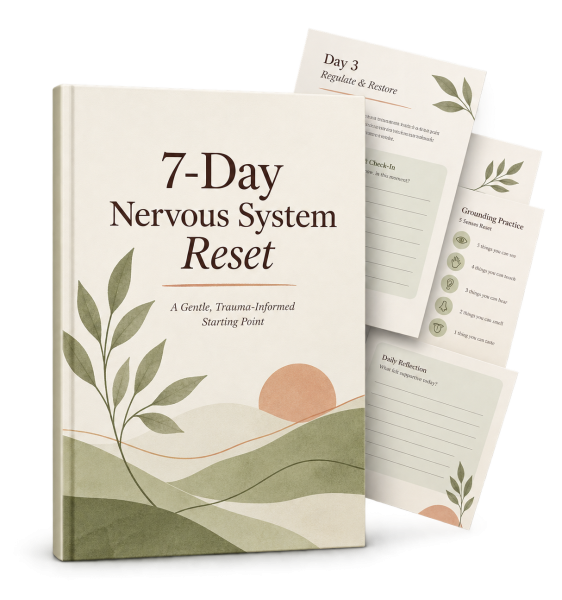
The free framework above shows you where to begin. The complete 7-Day Nervous System Reset gives you a guided page for each day so that you do not have to hold the entire plan in your head.
- One manageable focus for each day
- Minimum-care and demand-reduction prompts
- Gentle grounding and orientation practices
- Space to record what you notice
- Digital access with printable pages
- Complete it at your own pace
Digital guide • Instant access • One-time purchase
Educational and reflective support only. This guide is not therapy, medical treatment or a substitute for professional care.
When Additional Support Is Important
Seek assessment from an appropriately qualified health professional if symptoms are persistent, worsening, affecting daily functioning or difficult to understand.
- Severe or recurring panic
- Persistent numbness or dissociation
- Inability to sleep or function
- Significant changes in appetite, energy or concentration
- Chest pain, fainting or unexplained physical symptoms
- Medication or substance concerns
- Depression or hopelessness
- Thoughts of harming yourself or someone else
- Feeling currently unsafe
If there is immediate danger in Australia, call Triple Zero (000). For 24-hour crisis support, contact Lifeline on 13 11 14.
Questions About the Gentle 7-Day Reset
You Do Not Have to Hold the Whole Week in Your Head
Follow one manageable focus each day with the complete 7-Day Nervous System Reset.



IF EVERYTHING FEELS TOO MUCH RIGHT NOW
You Only Need to Begin With the Next 24 Hours
You do not need to rebuild your entire life today.
The free 24-Hour Emotional Recovery Starter Guide offers gentle, practical support for reducing immediate overwhelm, meeting basic needs and deciding what deserves your attention first.
Once the immediate shock becomes more manageable, you can begin considering what accountability, repair or separation would need to look like.