
Written by Sarah ‘Sy’ Taylor
Former First Responder – Trauma-Informed Writer – Founder of The Inner Growth Path
Rebuilding identity after emotional collapse
Why do relationships often change or end after three months?
If a relationship has ended, or suddenly changed, around the three-month mark, it can feel as though you missed a rule everyone else understood.
There is no universal deadline that makes relationships fail after three months. But this is often the point when the intensity and novelty of early dating begin to settle. People become less guarded, expectations become clearer and differences in communication, attachment, values and emotional availability are harder to overlook.
That does not automatically mean the relationship was false or that you did something wrong. It may simply mean you reached the point where attraction had to become something more sustainable: compatibility, honesty, emotional safety and the ability to repair difficulties together.
In this article, I’ll explain what can change around three months, how to distinguish a normal transition from a deeper incompatibility, and what this experience may reveal about your own relationship patterns.
THE SHORT ANSWER
Relationships do not automatically fail after three months. This is simply a common point at which early excitement settles and compatibility, expectations, attachment patterns and conflict styles become more visible. What matters is not the exact timeframe, but what the relationship reveals when it starts becoming real.
THE THREE-MONTH RULE
Is the Three-Month Relationship Rule Real?
The three-month rule is a popular way of describing a relationship pattern, not a scientifically established deadline.
Some relationships become serious before three months. Others remain uncertain for much longer. Healthy relationships can also experience doubt, conflict or changing levels of intensity without ending.
The three-month point matters because enough time has often passed for the relationship to become more realistic. You may begin spending time together in ordinary situations rather than carefully planned dates. Communication habits become clearer. Conversations about commitment, exclusivity and the future may begin.
The better question is not, “Why do all relationships fail after three months?”
It is:
What becomes visible when attraction is no longer enough to carry the relationship by itself?
What Really Changes Around Three Months?
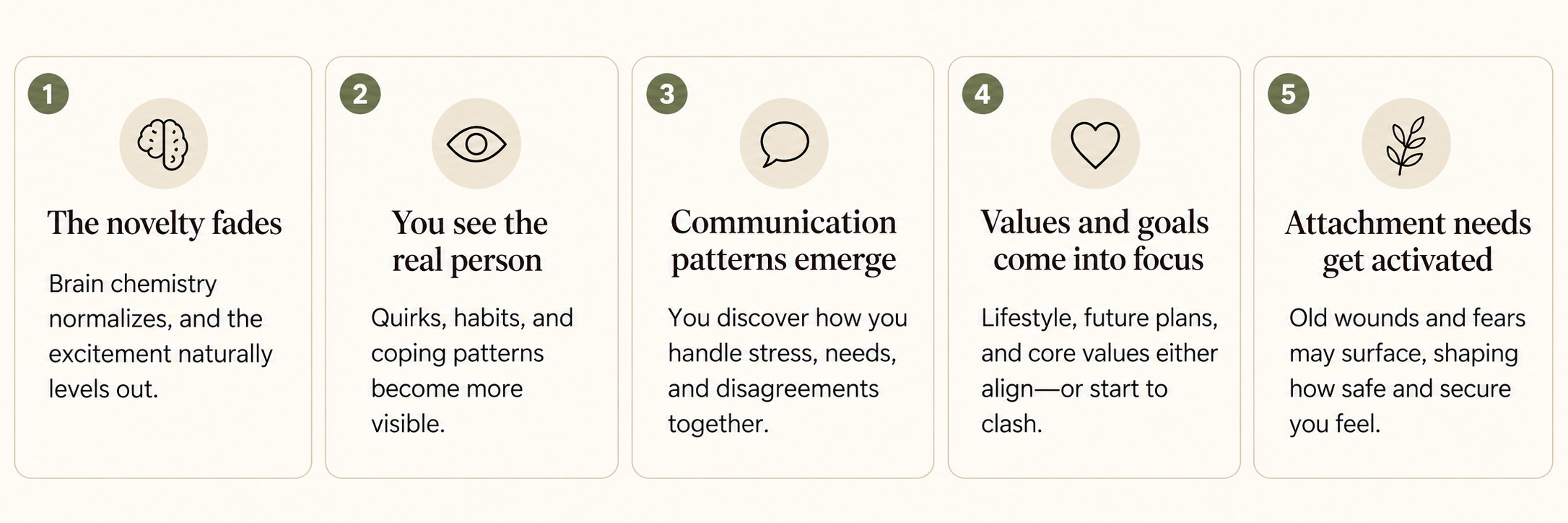
Something often begins to change around the three-month stage of dating.
The nervous first dates are behind you. You have spent enough time together to move beyond initial impressions, and the relationship begins to feel more like ordinary life than an exciting possibility.
This does not mean attraction has disappeared or that the relationship is beginning to fail. It means you are gaining better information about each other.
You may begin asking:
- How do we communicate when things get uncomfortable?
- Do our values align?
- How do we handle conflict?
- Do we feel emotionally safe together?
These questions can deepen a promising relationship. They can also reveal differences that were difficult to see during the excitement of the beginning.
1. Early Excitement Becomes Ordinary Life
At the beginning of a relationship, both people are usually showing their most attentive and accommodating sides.
Dates are planned. Messages are thoughtful. Differences may feel unimportant because the connection is still new and exciting. You may also fill in what you do not yet know about the other person with hope and possibility.
As time passes, it becomes harder, and less necessary, to remain the most polished version of yourself. You begin seeing how the other person behaves when they are tired, stressed, disappointed or distracted.
This is not necessarily the loss of the person you met at the beginning. It is the beginning of seeing a more complete version of them.
The important question is not whether every moment still feels exciting. It is whether what you are discovering feels compatible with the relationship you want.
2. Compatibility Becomes Clearer
Attraction can bring two people together, but it cannot resolve every practical or emotional difference between them.
Around three months, you may begin noticing differences in:
- How frequently you want to communicate
- How much time you expect to spend together
- How you give and receive affection
- Your values and priorities
- Your lifestyles and daily routines
- Whether you want exclusivity
- What you imagine for the future
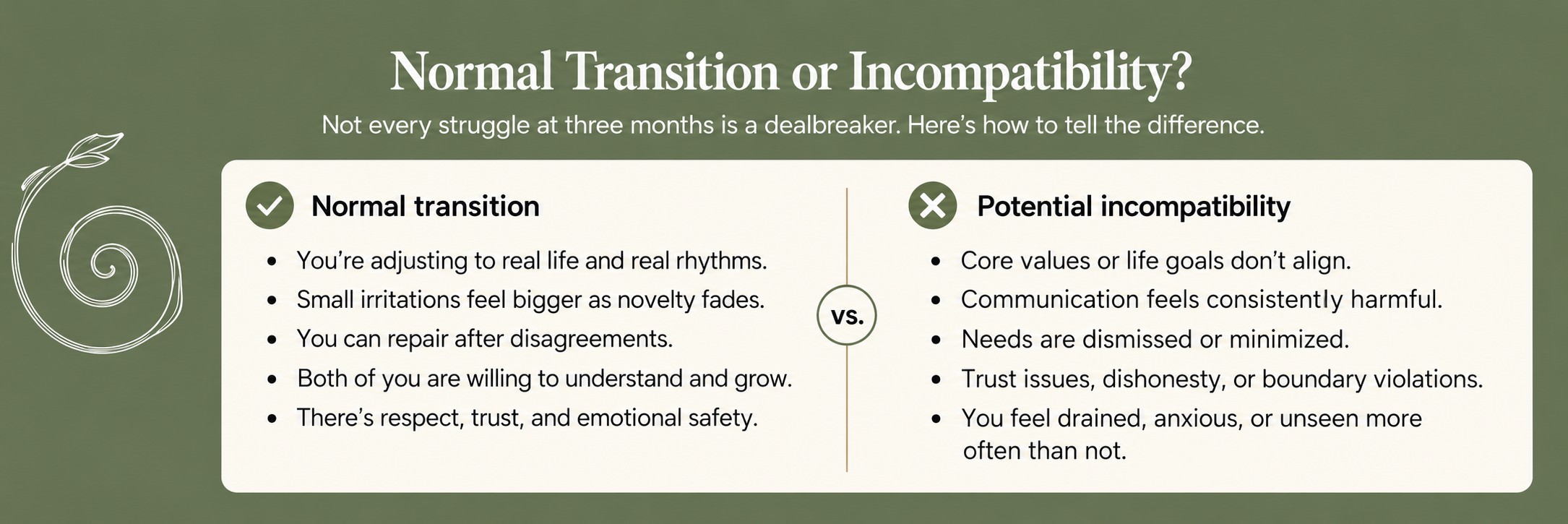
None of these differences automatically makes either person wrong. Two caring people can genuinely enjoy each other and still want different kinds of relationships.
The difficulty comes when important differences are ignored because both people are hoping the other will eventually change.
For example, one person may experience daily communication as an important form of connection, while the other needs much more independence. One person may be dating with the intention of building a committed relationship, while the other is enjoying the present without considering a future.
3. The Relationship Begins Asking for Clarity
Early dating can continue for a while without either person clearly defining what the relationship means.
Around three months, that uncertainty may become more difficult to ignore. One person may want to define the relationship while the other prefers to keep it casual or uncertain.
Questions begin to emerge:
- Are we exclusive?
- Are we building towards a committed relationship?
- Do we want the same things?
- Are we both emotionally available?
- Is this relationship becoming part of our lives, or does it only exist when it is convenient?
What looks like a sudden breakup may actually be the moment when two people finally acknowledge that they want different things.
Clarity can be painful, particularly when you hoped the relationship would become more. But remaining in prolonged uncertainty can be painful too.
Wanting an honest conversation does not make you demanding. It gives both people the opportunity to make an informed choice rather than continuing on assumptions.
4. Protective Relationship Patterns Can Appear
As closeness increases, people may begin protecting themselves in familiar ways.
One person might seek more reassurance while another withdraws or becomes harder to reach. Someone who fears rejection may begin overanalysing changes in communication. Someone who feels uncomfortable with dependence may create distance when the relationship becomes more emotionally significant.
Previous betrayal, abandonment or emotionally unsafe relationships can influence these reactions—but not every difficult relationship response is caused by trauma.
Sometimes a person is withdrawing because their interest has changed. Sometimes two people are incompatible. Sometimes concerning behaviour is genuinely happening in the present and should not be explained away as an attachment response.
This is why it helps to pause and separate three things:
- What has actually happened?
- What meaning am I giving it?
- What do I need to ask, communicate or observe next?
Understanding your emotional patterns should help you see a relationship more clearly. It should never pressure you to tolerate inconsistency, disrespect or behaviour that repeatedly leaves you feeling unsafe.
5. Conflict Reveals Whether Repair Is Possible
The appearance of conflict does not mean a relationship is failing.
In fact, the first disagreement can provide important information about how a relationship functions when everything is no longer easy.
More useful questions are:
- Can both people explain how they feel without attacking each other?
- Can each person listen without immediately becoming defensive?
- Can someone acknowledge the impact of their behaviour?
- Is there room for both people’s needs?
- Do apologies lead to meaningful change?
- Does the relationship feel safer after repair—or increasingly confusing?
Healthy repair does not require perfect communication. People can misunderstand each other, become defensive or need time to calm down.
What matters is whether both people are willing to return to the conversation, take responsibility for their part and make a genuine effort to understand each other.
Conflict becomes more concerning when it involves punishment, contempt, intimidation, repeated blame, prolonged withdrawal or pressure to surrender your boundaries simply to restore the connection.
Three months is not a deadline that determines whether a relationship will survive. It is simply a point when the relationship may begin providing clearer evidence.
The real question is not, “Have we made it beyond three months?”
It is: “What is this relationship showing me now that I can see it more clearly?”
If you are struggling to separate genuine love from the fear of losing someone, read Attachment vs Love: How to Tell the Difference and Build Healthier Relationships.
NOTICE THE PATTERN
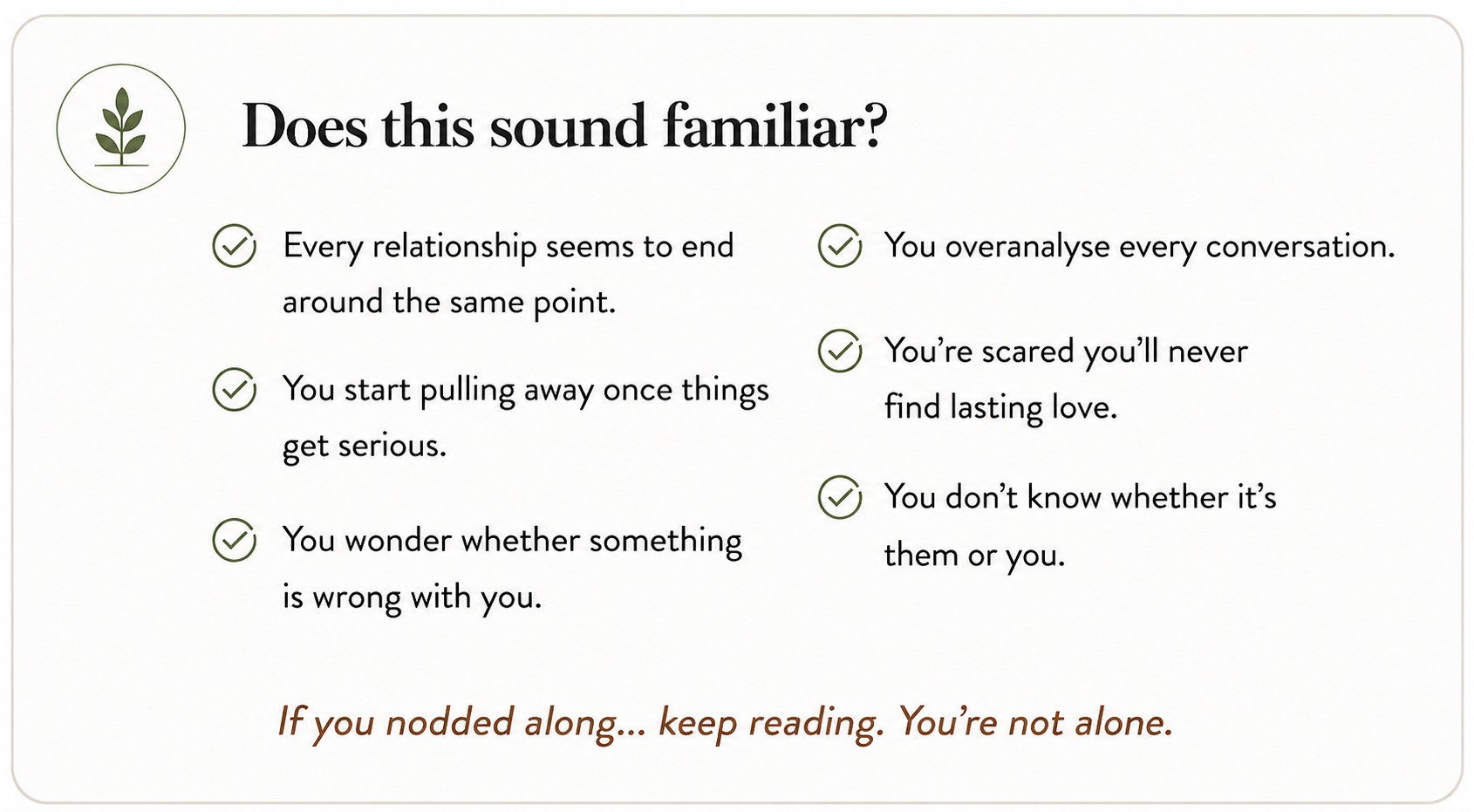
Do You Keep Encountering the Same Relationship Patterns?
When uncertainty enters a relationship, it can activate patterns that are difficult to recognise while you are inside them.
The 12 Hidden Patterns That Quietly Destroy Relationships workbook can help you identify what may be repeating, what it has cost you and what you want to recognise earlier.

FROM MY OWN EXPERIENCE
The Three-Month Pattern I Noticed in My Own Relationships
For a long time, I thought it was just coincidence.
In between two long-term relationships, one lasting four and a half years and another around three, I spent about four years dating. During that time, I experienced what I now call the three-month phenomenon.
Nearly every connection, no matter how exciting or promising, seemed to quietly dissolve around the three-month mark.
It wasn’t ghosting.
It wasn’t dramatic arguments.
It was simply a slow realisation that something wasn’t working—or worse, the quiet feeling that I was somehow expected to prove my worth.
And I had promised myself I would never do that again.
At first, I treated three months like an expiry date. If the connection changed, I assumed I had reached the same inevitable ending again.
Looking back, the timeframe was not the real pattern. The pattern was what happened inside me when the relationship became uncertain. I began watching for rejection, questioning whether I was wanted and feeling as though I had to prove why I was worth choosing.
Three months was simply the point when chemistry stopped distracting me from those deeper questions.
When Being Chosen Felt Like Proof of Love
I remember this moment vividly in my last relationship.
At the three-month mark, we hit that inevitable tension.
I had already told myself:
This isn’t going to last.
It’s just another short one.
So I detached.
I let it go. I told her I wished her the best.
But she showed up.
She came to my apartment and said, No—we’re talking about this.
At the time, I experienced her insistence on continuing the conversation as fighting for me.
And in that moment, something inside me melted.
That felt like love.
That felt like being chosen.
And it was powerful enough for me to drop my walls and believe I could trust her.
What I didn’t see back then was the deeper complexity underneath it. Over time I realised there were other dynamics involved—unhealed wounds, emotional volatility, and traits that made the relationship far more chaotic than I initially understood.
But because she stayed past that three-month tipping point, because she chose me, I went all in.
Because she stayed beyond the point where I expected the relationship to end, I treated being chosen as evidence that the relationship must be right.
It took me much longer to understand that persistence is not the same as compatibility. Being intensely wanted is not the same as feeling consistently safe, respected or able to remain yourself.
When Closeness Activates Self-Protection
Even when we deeply want a relationship, increasing closeness can feel exposing.
You might begin overanalysing changes in communication, seeking reassurance, pulling away before the other person can reject you or ignoring concerns because losing the relationship feels unbearable.
A protective response does not automatically mean the relationship is wrong. It also does not mean every concern is merely your trauma.
Try separating three things:
What has actually happened?
What meaning am I giving it?
What do I need to ask, communicate or observe next?
This creates enough space to respond to the relationship in front of you rather than automatically reacting from an earlier experience.
IDENTITY REBUILD REMINDER
Understanding a reaction does not require you to blame yourself for everything that happens in a relationship.
The Deeper Question: Can I Still Be Myself Here?
Looking back now, I see something important.
The three-month mark wasn’t just about compatibility.
It was also about emotional visibility.
Around that time, relationships stop being about attraction and start becoming about who we really are.
That can feel confronting.
It’s when we begin to ask:
- Can I be fully myself here?
- Do I feel safe being seen?
- Am I repeating old patterns?
What most dating advice gets wrong is the idea that early relationship friction means something is broken.
Sometimes it simply means the relationship has reached the point where authenticity begins.
And authenticity always reveals something.
When a relationship becomes uncertain, it is natural to focus on the other person:
Do they still want me?
Will they choose me?
What did I do wrong?
But the Identity Rebuild Path asks a different question:
Can I still be myself here?
Ask whether you can:
A relationship can challenge you without requiring you to abandon yourself. If keeping the connection means becoming quieter, less honest or increasingly disconnected from who you are, that deserves your attention.
A GENTLE REFLECTION
Seven Questions to Ask at the Three-Month Mark:
What has actually changed?
Have we spoken clearly about what we both want?
Do this person’s words and behaviour generally match?
How do we respond to disagreement?
Am I reacting to this relationship or reliving an earlier one?
Do I feel increasingly able—or increasingly unable—to be myself?
If I were not afraid of losing this person, what would I notice?
Do not use these questions to force an immediate decision. Use them to replace panic, fantasy or self-blame with clearer observation.
Do You Want to Understand What Keeps Repeating?
If this experience feels familiar rather than isolated, the 12 Hidden Patterns workbook can help you identify what may be repeating, what it has cost you and what you want to recognise earlier in future.
ABOUT THIS ARTICLE
Sources and Perspective
The “three-month rule” is a popular description of an early relationship transition—not a scientifically established deadline. Relationships develop at different speeds, and research does not identify three months as a universal point when relationships succeed or fail.
The psychological discussion in this article draws on research into early romantic attraction, adult attachment and recovery after relationship conflict. Research suggests that early romantic love can involve heightened reward, motivation and emotional focus; that attachment anxiety and avoidance can influence how people respond to increasing closeness and stress; and that the way partners recover after conflict is associated with relationship satisfaction and stability.
This article also includes my lived experience. It is intended to support education and reflection—not to diagnose either person or determine whether a relationship should continue.
Research referenced
- Fisher, Aron and Brown: Intense, Passionate, Romantic Love—A Natural Addiction?
- Simpson and Rholes: Adult Attachment, Stress, and Romantic Relationships
- Salvatore and colleagues: Recovering From Conflict in Romantic Relationships: A Developmental Perspective
Written from lived experience by Sy Taylor. Last updated September 2026.
FAQs About Relationships Ending After Three Months
BEGIN WITH THE FREE GUIDE
Has This Relationship Left You Emotionally Overwhelmed?
If you are trying to understand what happened while also managing the emotional aftermath, the free 24-Hour Emotional Recovery Starter Guide will help you steady yourself first.
You may also need:


Choose the next step that best matches what you are experiencing now:
One Helpful Resource: