
Written by Sarah ‘Sy’ Taylor
Former First Responder – Trauma-Informed Writer – Founder of The Inner Growth Path
Rebuilding identity after emotional collapse
This article shares personal experience and trauma-informed education. It is not medical advice or a substitute for individual mental-health support.
Feeling disconnected from yourself can be difficult to explain. You may be functioning, speaking to people and completing ordinary tasks while feeling emotionally absent from your own life.
Your feelings may seem muted. Your body may feel distant. You may struggle to recognise what you need, what you enjoy or how you genuinely feel about the people and choices around you.
Some people describe it as going through the motions. Others feel as though they are watching themselves live rather than fully participating. The experience may involve emotional numbness, exhaustion, constant thinking, social withdrawal or a disturbing sense of unfamiliarity.
Disconnection can occur after trauma, heartbreak, burnout, grief or prolonged stress. It can also overlap with depression, anxiety, dissociation, physical illness, medication effects and exhaustion. This article will help you understand the experience without assuming one explanation applies to everyone.
THE SHORT ANSWER
Feeling disconnected from yourself means that parts of your inner experience—such as your emotions, body signals, preferences or sense of identity—feel distant, muted or difficult to access.
Emotional overwhelm can contribute to this, but disconnection is an experience rather than a diagnosis. Its cause cannot be determined from one symptom or checklist.
What Does Feeling Disconnected From Yourself Mean?
Feeling disconnected from yourself does not always mean the same thing. One person may feel emotionally numb while still knowing exactly what they think. Another may experience strong emotions but feel detached from their body, needs or identity.
The common thread is reduced access to some part of your internal experience. You may know intellectually that something matters without being able to feel its importance. You may recognise that you need rest without noticing exhaustion until you collapse. You may participate in relationships while feeling as though you are performing rather than connecting.
Disconnection can therefore occur in several different areas. You may feel disconnected from your emotions while remaining aware of your values. You may know what you feel but struggle to notice your body’s signals. You may feel present when alone but absent or performative around other people.
Identifying where the distance appears is more useful than treating “disconnected” as one single condition.
DISCONNECTION IS NOT ONE EXPERIENCE
You can feel distant from your emotions, your body, your needs, your relationships or your identity. These experiences can overlap, but they do not always have the same cause.
How Overwhelm Can Contribute to Disconnection
When an experience feels overwhelming, your attention may narrow towards immediate demands, danger or emotional survival. Feelings, physical signals and personal preferences can become harder to notice while most of your capacity is occupied elsewhere.
Emotional distance can sometimes function protectively. Feeling less may temporarily reduce distress when fully experiencing grief, fear, betrayal or exhaustion seems unmanageable.
However, disconnection is not always a trauma response. Depression, anxiety, burnout, grief, sleep deprivation, physical illness, medication, substance use and dissociative experiences can produce overlapping symptoms. More than one factor may be involved.
Understanding the context matters more than assigning yourself a label. Notice when the disconnection began, what intensifies it, where it decreases and how it affects your daily life.
If you feel detached but also constantly watchful or unable to relax, read What Survival Mode Really Is.
Four Ways Disconnection Can Show Up
Rather than asking only whether you feel disconnected, look at which part of your inner experience feels difficult to access. The following forms of disconnection often overlap, but one may be more recognisable than the others.
1 — EMOTIONAL DISCONNECTION
Your Feelings Seem Muted or Unavailable
You may understand intellectually that something matters without being able to feel it. Joy, affection, sadness, excitement or anger may seem distant, flattened or delayed.
This can feel like not caring, but reduced emotional access is not necessarily an absence of care. Exhaustion, depression, grief, overwhelm and protective detachment can all contribute to emotional numbness.
Continue understanding: If numbness and depletion are central, read Emotional Exhaustion After Trauma.
NOTICE
Which feelings are difficult to access? Are all emotions distant, or are certain emotions—such as anger, grief or joy—less available than others?
2 — BODY DISCONNECTION
Your Body’s Signals Are Difficult to Read
You may not notice hunger, tension, fatigue or discomfort until those sensations become intense. You might know that you need rest without feeling tired—or recognise that a situation is uncomfortable only after leaving it.
Some people feel detached from their body or experience it as unfamiliar. Others feel physically tense but cannot connect that tension with an identifiable emotion or need.
Persistent feelings of unreality, observing yourself from outside your body or experiencing the world as unreal may relate to depersonalisation or derealisation. These experiences deserve assessment by an appropriately qualified professional.
The NHS overview of dissociative disorders explains depersonalisation as feeling outside yourself and derealisation as experiencing the world around you as unreal.
NOTICE
Which physical signals do I recognise easily? Which ones do I tend to notice only after they become overwhelming?
3 — DISCONNECTION FROM NEEDS AND PREFERENCES
You Cannot Tell What You Want
When you have spent a long time responding to other people, meeting demands or trying to remain safe, your preferences can become difficult to hear.
You may answer “I don’t know” when asked what you want. Decisions feel disproportionately difficult. You might choose whatever creates the least conflict or rely on other people to identify what should matter to you.
This does not necessarily mean you have no preferences or identity. It may mean that your own signals have repeatedly been postponed, ignored or overridden.
ASK YOURSELF
When I make an ordinary choice, do I notice what I prefer—or do I first calculate what will be easiest or most acceptable for everyone else?
4 — RELATIONAL AND IDENTITY DISCONNECTION
You Feel Present Physically but Absent From Your Life
You may participate in conversations, relationships and responsibilities while feeling as though you are performing your role rather than inhabiting it.
Around other people, you might automatically become agreeable, capable, helpful or emotionally contained. Afterwards, you may feel exhausted or realise that you never expressed what you genuinely thought or felt.
If this continues across many areas of life, the distance can begin affecting identity. You no longer know whether the version other people see reflects you, protects you or simply helps you function.
If the problem has expanded into not recognising your personality, confidence or future, read Identity Loss After Trauma.
NOTICE
Where do I feel most natural and present? Around whom do I become more performative, distant or difficult to locate?
What Most Advice Gets Wrong About Disconnection
Telling someone to think positively, choose happiness or stop dwelling on the past assumes that connection can be restored through pressure.
But you cannot shame yourself into greater emotional access. Self-criticism may make you monitor yourself more closely while becoming even less able to identify what you genuinely feel or need.
Disconnection may have a protective purpose, but that does not mean every case has the same explanation. The more useful response is curiosity: What feels distant? When did the distance begin? What intensifies it? Where does some sense of connection return?
What I Initially Misunderstood About My Own Disconnection
After my own life fell apart, I thought I had become cold, detached and emotionally unavailable. I was still functioning, but I did not feel fully present in my life, relationships or body.
What changed my understanding was recognising that the distance was not the complete truth about my character. PTSD, betrayal, career loss and prolonged exhaustion had affected how much emotional and physical information I could access at once.
Learning about trauma responses helped me replace some of the shame with context. Slowing down, reducing overstimulation, walking, honest journalling, rest, safe relationships and trauma-informed professional support all helped me notice moments when more of myself became available.
None of these things offered an instant return to who I had been. They helped me recognise that connection could vary—and that the moments when it returned contained useful information.
What Can Your Disconnection Help You Understand?
These questions are not a test or a way to force reconnection. Use them to observe where distance appears and what may influence it.
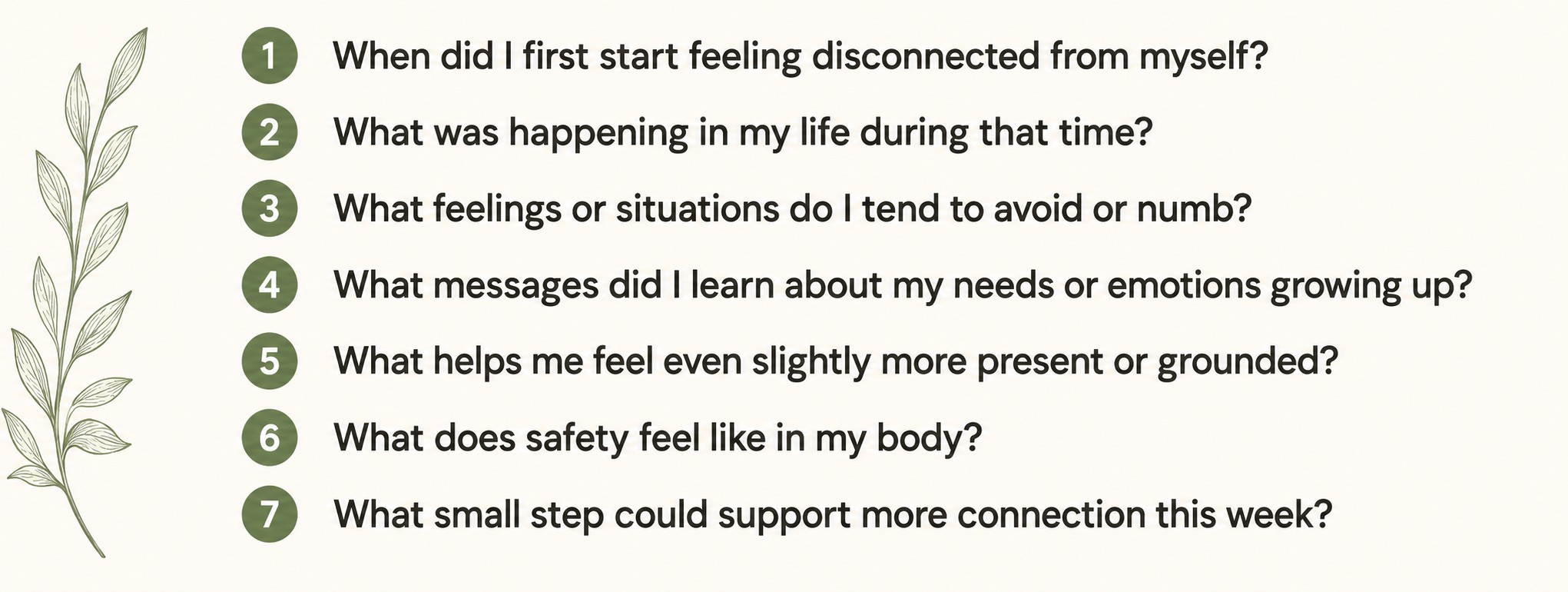
Do not use these questions to diagnose yourself. Use them to replace a vague sense that something is wrong with clearer observation.
When Feeling Disconnected Needs Additional Support
Consider speaking with a qualified health professional if disconnection is persistent, worsening or interfering with work, relationships, self-care or daily responsibilities.
Professional assessment is especially important if you experience memory gaps, severe depression, panic, substance misuse, feeling unreal, feeling outside your body or believing the world around you is unreal.
Seek urgent local support if you may harm yourself, cannot remain safe or are unable to care for your immediate needs.
Frequently Asked Questions



A GENTLE PLACE TO BEGIN
You Only Need to Begin With the Next 24 Hours
When everything feels too much, even the idea of recovery can become another overwhelming demand.
The free 24-Hour Emotional Recovery Starter Guide helps you focus only on what may support you today—without asking you to solve everything at once.
I created this guide from the kind of support I needed when my own life felt impossible to hold together.