STAGE 4: RECONNECT
What Does Reconnection Mean?
Reconnection means rebuilding contact with the parts of yourself that became difficult to hear during trauma, loss or prolonged survival.
It involves noticing your preferences, needs, boundaries, values and emotional responses—and allowing them to matter again.
You may not return to the person you were before everything changed. Some roles, relationships and beliefs may no longer fit. Reconnection is the gradual process of discovering what remains true, what has changed and what you want to carry forward.
You do not need complete certainty. Identity becomes clearer through small choices, lived experience and repeated moments of self-trust.
RECONNECTION IS NOT REINVENTION
You do not need to create an entirely new person or force yourself back into an old identity.
The aim is to become more available to your present self—then let your future direction develop from what you notice, choose and experience.
Signs You May Be Ready to Reconnect
Reconnection does not begin at one precise moment. You may still experience grief, uncertainty or difficult days while also noticing that something in you is becoming ready to look forward.
You do not need to recognise every sign. One or two may be enough to show that your needs are beginning to shift.
The Immediate Crisis Has Eased
You may still have difficult moments, but most of your energy is no longer required simply to get through the day.
You No Longer Know What You Want
You can recognise what has ended or stopped fitting, but you cannot yet hear a clear preference or direction.
Your Old Identity No Longer Fits
The roles, labels or expectations that once defined you feel incomplete, unfamiliar or too small for who you are now.
You Want to Trust Yourself Again
You are becoming ready to rely on your own judgement, choices and emotional signals after a period of doubt or disconnection.
You Feel Lost Without the Old Future
The life you expected may no longer be possible, and you need help imagining direction without recreating the past.
Curiosity Is Beginning to Return
You notice small sparks of interest, preference or possibility—even if they are quiet, inconsistent or difficult to explain.
You do not need to feel completely healed before reconnecting with yourself. Readiness may appear as nothing more dramatic than wanting to know what feels true now.
How to Reconnect Without Forcing It
After losing contact with yourself, it can be tempting to search for one decisive answer: a new identity, purpose, relationship or life plan.
But reconnection usually develops through attention and experience—not through forcing certainty. The aim is to create enough space to notice what feels true now.
FOCUS ON
AVOID
Reconnection is not a performance of confidence. It is the practice of noticing yourself, allowing your experience to matter and making choices you can learn from.
Do You Need an Earlier Stage?
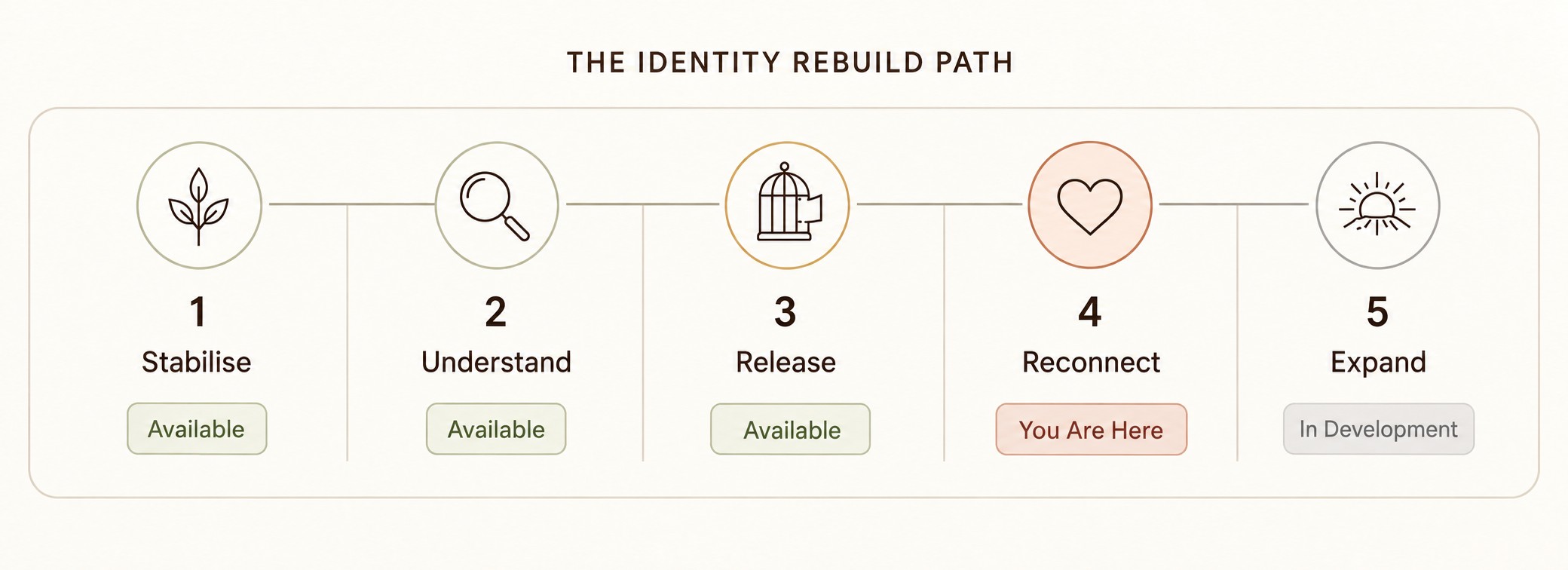
Reconnection is easier when you have enough stability to notice yourself clearly. If Stage 4 feels premature, choose the earlier stage that best reflects what you need now.
Stage 1 — Stabilise
If you feel overwhelmed or unsafe
Begin here if your nervous system is frequently activated, everyday functioning feels difficult or you need practical support for getting through the immediate period.
Stage 2 — Understand
If you need to understand what happened
Begin here if you are trying to make sense of your reactions, relationship patterns, trauma responses or why the experience affected you so deeply.
Stage 3 — Release
If your life is still organised around the past
Begin here if you remain emotionally caught in a relationship, role, betrayal, unanswered question or future that did not happen.
You do not have to complete one stage perfectly before moving to another. Return to the stage that offers the most useful support today.
CHOOSE WHAT YOU NEED NOW
Choose Your Reconnection Starting Point
You do not need to work on every part of your identity at once. Choose the starting point that most closely describes what feels difficult now.
Each path offers a different kind of support. If more than one fits, begin with the one that feels most immediate.
I Feel Lost and Need Direction
Your old life no longer fits, but you cannot see what should come next.
Identify whether you are depleted, disconnected, grieving, misaligned or genuinely directionless—and choose one realistic place to begin.
I Am Ready to Rebuild My Identity
You understand that your former identity cannot simply be restored, and you are ready to begin building forward.
Separate your roles from your enduring qualities, recover your preferences and create identity through small lived evidence.
Not sure you are ready to rebuild?
If you are still trying to understand why you no longer recognise yourself or why you feel disconnected from who you are, Stage 2 may be the more useful place to begin.
The Reconnection Process
Reconnection develops as you notice yourself more clearly, loosen identities that no longer fit and build trust through lived experience.
Notice
Pay attention to what you feel, need, enjoy, resist or feel curious about now.
What am I noticing about myself lately?
Separate
Distinguish your identity from the roles, relationships and expectations that have shaped it.
Is this part of me—or something I learned to become?
Choose
Make small decisions that reflect what you currently know about your needs, values and boundaries.
What choice feels most honest today?
Test
Try new directions as experiments rather than permanent declarations about who you are.
What could I test without committing forever?
Trust
Let repeated experiences show that you can listen to yourself, choose and adjust.
What evidence do I have that I can trust myself?
You do not think your way into a complete new identity. You develop it through repeated experiences of noticing, choosing and trusting what feels true.
A LIVED PERSPECTIVE
What Reconnection Looked Like for Me

When my marriage ended and my career in policing could no longer hold the future I had imagined, I did not immediately know who I was without those parts of my life.
Reconnection was not one dramatic moment of finding myself again. It began through smaller experiences: noticing what I genuinely enjoyed, recognising when something did not feel right, allowing my needs to matter and making choices that were not built entirely around duty or survival.
Over time, those choices gave me evidence. I was not recovering a fixed version of who I had been. I was learning that identity could be rebuilt through the way I lived, what I allowed and what I chose next.
I did not need to know exactly who I was becoming. I needed to become willing to notice who I was now.
When Reconnection Feels Difficult to Do Alone
Reconnecting with yourself can bring up grief, uncertainty and difficult questions about identity, relationships or the life you expected to have.
Professional support may be helpful if attempts to explore who you are leave you feeling overwhelmed, emotionally unsafe or increasingly unable to manage everyday life. A trauma-informed psychologist, counsellor or other qualified professional can help you work at a pace that respects both your history and your current capacity.
Seeking support does not mean you have failed to rebuild independently. Sometimes a safe therapeutic relationship provides the stability needed to hear yourself more clearly.
If you are in immediate danger or believe you may harm yourself or someone else, contact your local emergency service or crisis-support provider.
WHAT COMES NEXT
When Reconnection Becomes Expansion
As you reconnect with your needs, values and direction, you may begin to feel ready for something beyond recovery.
Expansion is the stage where the question gradually shifts from “Who am I now?” to “What do I want to create with the life I have?”
This may involve new relationships, meaningful work, creativity, community, adventure or contribution. It is not about constant growth, achievement or proving how far you have come. It is about building a life with enough space for possibility, purpose and enjoyment.
You do not need to rush toward Stage 5. Reconnection becomes expansion naturally when you have enough trust in yourself to begin choosing not only what feels safe—but what feels meaningful.
Expansion begins when life is no longer organised only around what you survived.

START WHERE YOU ARE
Need Something Gentler to Begin With?
If reconnecting with yourself feels too far ahead right now, begin with the next 24 hours.
What to Do When Your Life Falls Apart is a free trauma-informed guide designed to help you reduce pressure, identify what needs attention first and take a few manageable steps when everything feels overwhelming.
Still struggling to get through the day? Begin with Stage 1: Stabilise and focus first on helping life feel safer and more manageable.